
From the Pinhole · Lesson 4
Why is 1839 called the birth of photography? The daguerreotype
The text version of a lesson from Photography with Travis Zhang. All lessons →
In short: because in 1839 a way of taking photographs was made public for the first time, one that anyone could learn and use. Photographs already existed: Niépce had captured the view from his window around 1827. But on 19 August 1839 France publicly explained every step of Daguerre's daguerreotype process and declared it a gift to the world. The daguerreotype cut exposures from hours, even days, to minutes, and photography became a craft anyone could learn.
If photographs already existed, why is 1839 the birth year?
Because the date marks the method becoming public, not the first photograph. Niépce's plate needed hours, quite possibly days, of exposure, and his process was never published. In 1839 the daguerreotype was published in full; the manual went through edition after edition and was translated into many languages, and Paris shops began selling complete outfits.[1]
Some count from Niépce's plate instead. It is dated to either 1826 or 1827, so both 2026 and 2027 are being marked as photography's 200th anniversary.[2] The two counts celebrate different things: one the first photograph, the other photography for everyone.
Who was Daguerre?
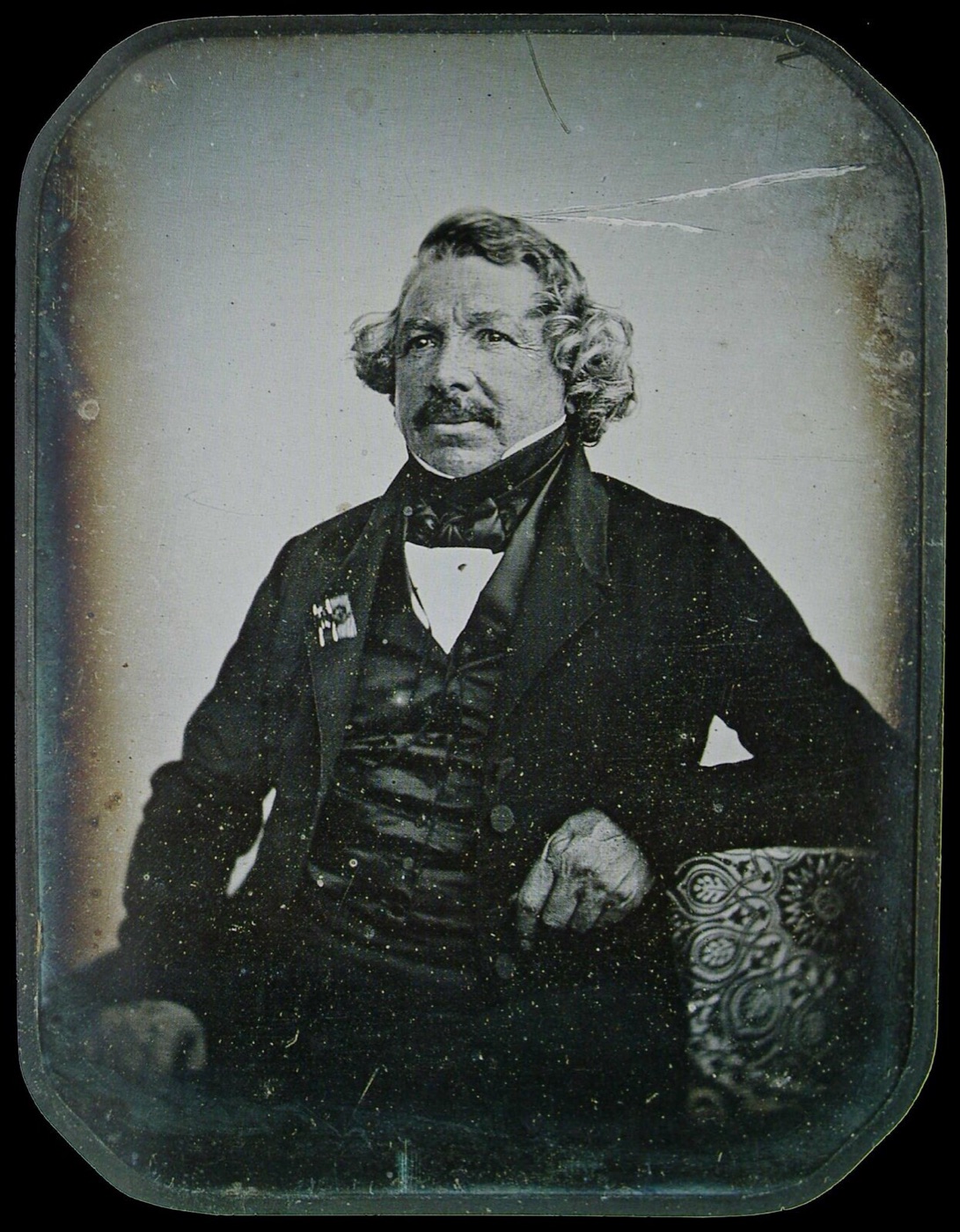
Louis Daguerre was born near Paris in 1787 and trained in architecture and stage design; he also painted huge panoramas.[3] In 1822 he and the painter Charles-Marie Bouton opened the Diorama in Paris, a theatre that used skylights, shutters and coloured blinds to make the same giant painting turn slowly from day to night.[4] He often used a camera obscura for his compositions. Around 1826 he heard about Niépce from the Paris opticians Chevalier, and in 1829 the two men signed a partnership agreement.[5]
How does a daguerreotype make a picture?
In three steps: sensitise the plate with iodine, develop it with mercury, then fix it.[1]
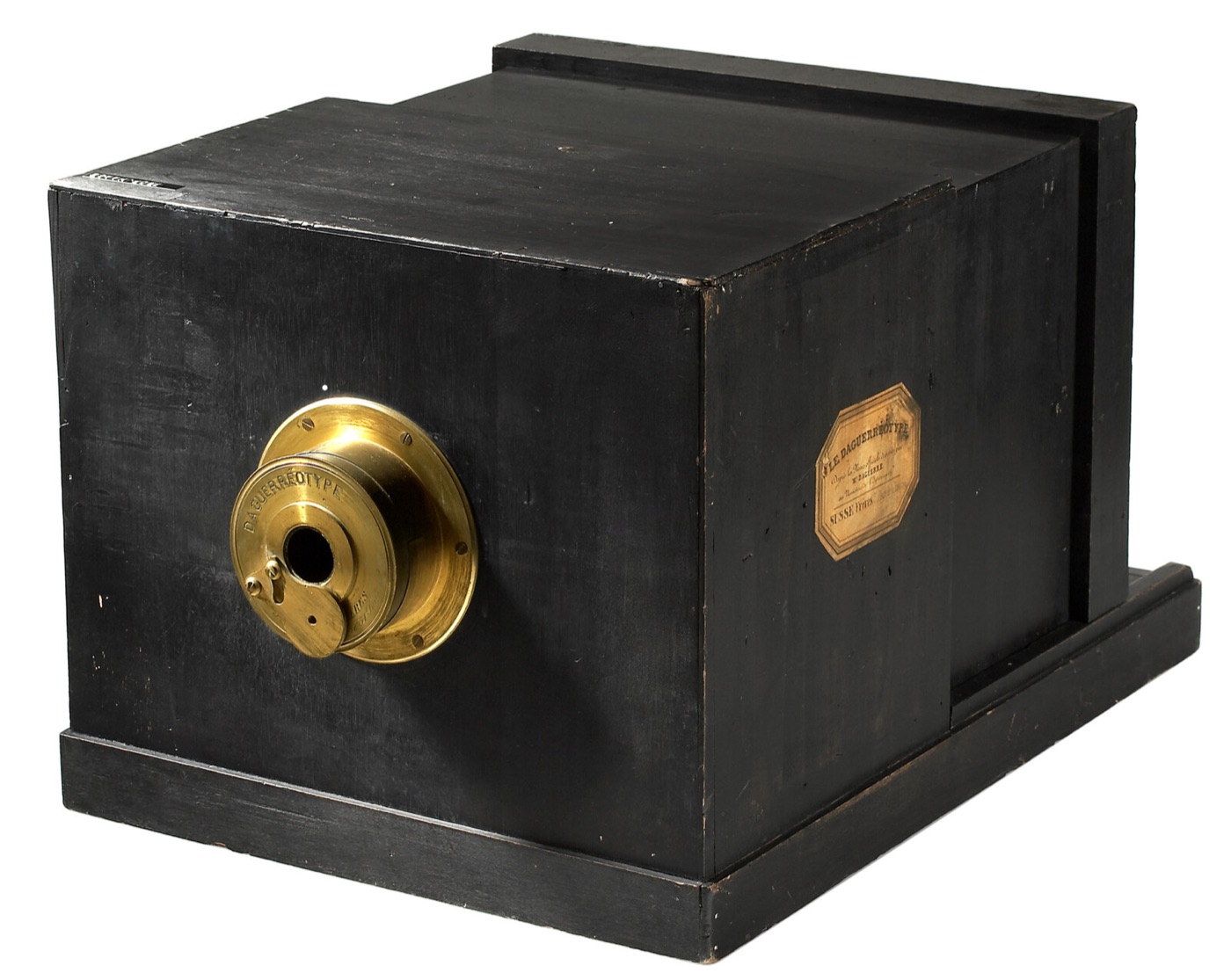
- A silver-plated copper plate is polished to a mirror and exposed to iodine fumes in the dark, which forms a very thin layer of silver iodide and makes the plate sensitive to light.
- After an exposure of a few minutes, the plate carries an invisible latent image. Mercury heated to around 70 °C is allowed to fume over it for a few minutes; the vapour settles mainly where light struck, and the picture appears.
- Finally the unexposed silver iodide is washed away. Daguerre first used hot salt water; photographers later switched to "hypo" (sodium thiosulfate), which darkrooms still use.
Mercury vapour is poisonous. The popular story that a broken thermometer in a cupboard developed the first image is regarded by most historians today as invented.
What is the first photograph of a person?
It is generally said to be Daguerre's Boulevard du Temple. On a spring morning in 1838 (some say 1837), at eight o'clock, he photographed this busy Paris street from his studio window. The exposure took several minutes, so carriages and walkers left no trace; only a man standing on a street corner having his boots shined, and the bootblack, stayed still enough to be recorded.[6] The original plate was damaged by damp during the Second World War and nearly wiped clean when it was cleaned in the 1970s; what we see today is a copy photographed in 1936.[2]
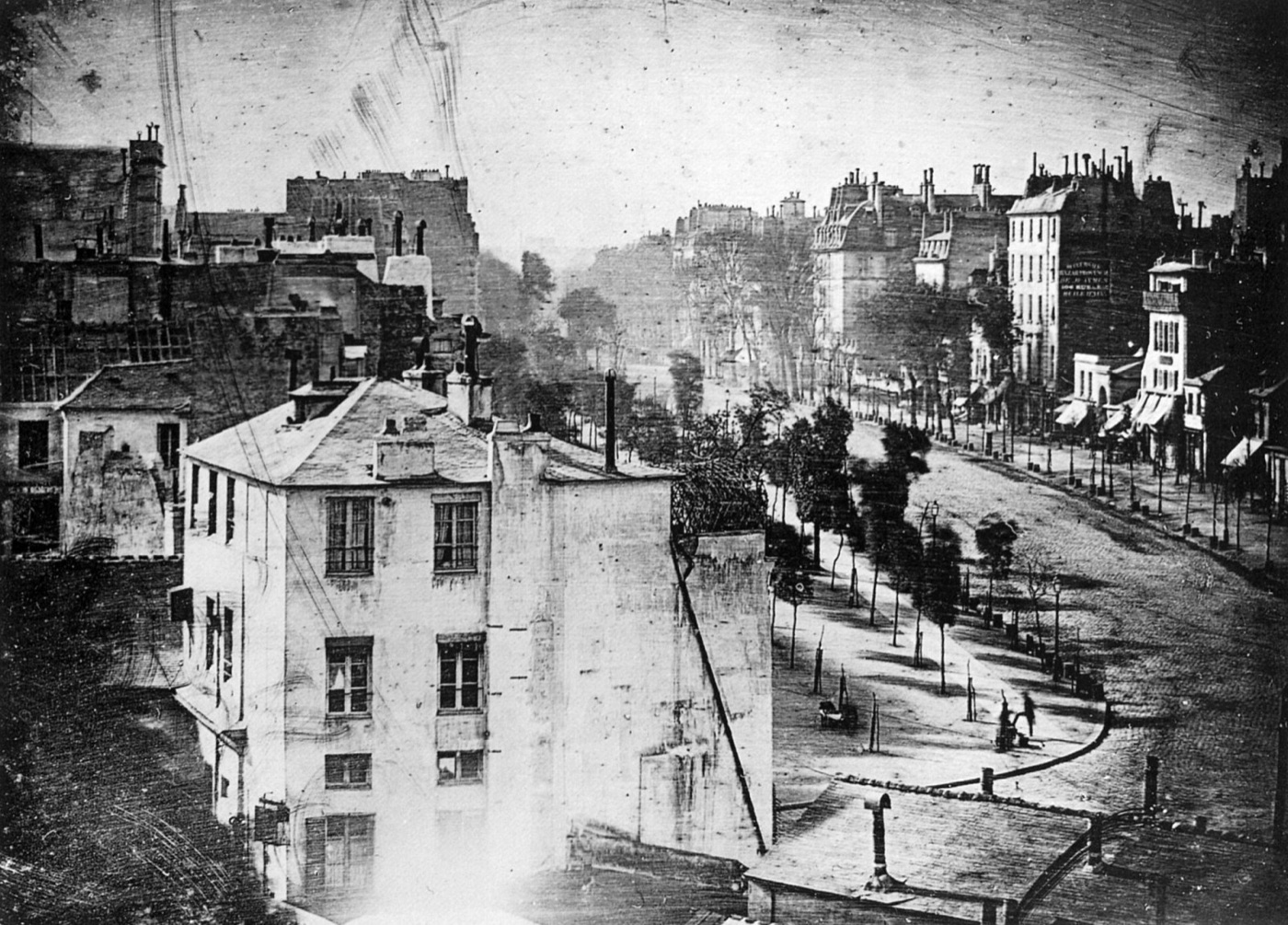
On 15 October 2026, Paris set a bronze plaque into the Place de la République marking where the two men stood. Three Swedish filmmakers spent two years scanning the neighbourhood and studying old maps; their first step was to flip the familiar image back, because it is mirror-reversed.[2]
Why did France give the daguerreotype "to the world"?
Because it would not sell, and François Arago came up with the idea of the state buying it. In spring 1838 Daguerre and Niépce's son Isidore tried to sell the secret by subscription, 1,000 francs a share with at least 100 subscribers, but could not find enough buyers.[7] Arago was an astronomer, a member of parliament and permanent secretary of the French Academy of Sciences. On 7 January 1839 he announced the invention to the Academy, without revealing how it worked.[7]
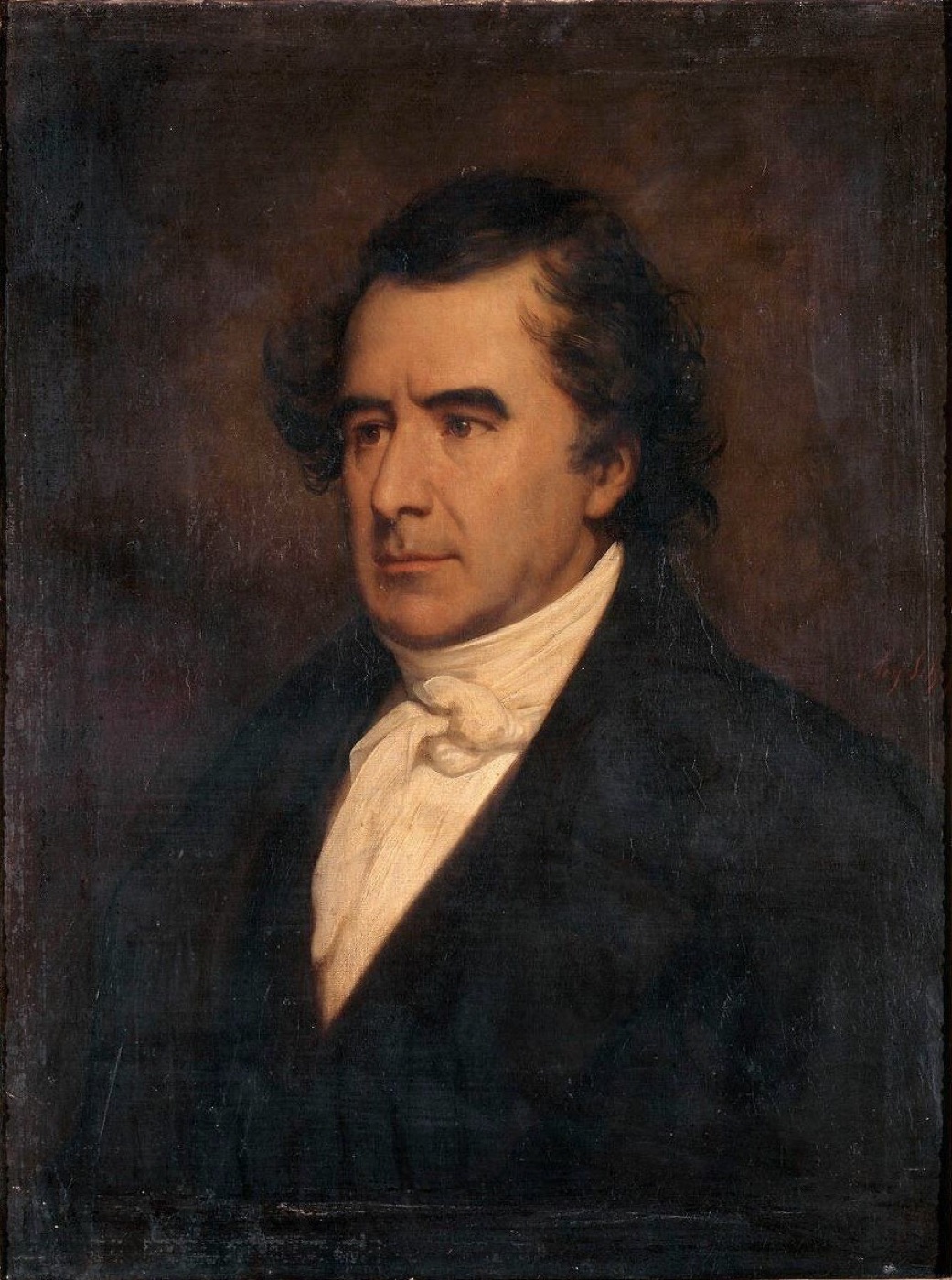
In summer 1839 the French parliament passed a law granting Daguerre 6,000 francs a year and Isidore 4,000 francs a year for life.[7] On 19 August the Academy of Sciences and the Academy of Fine Arts held a joint meeting at the Institut de France, and Arago explained every step in public: anyone could use it without paying a licence. The one exception was England, where Daguerre's agent had applied for a patent five days earlier.[1] World Photography Day falls on 19 August to mark that day.
What does a daguerreotype look like?
Like a picture on a mirror, and every one is unique. Highlights are tiny grains formed in development, shadows are polished silver, so you have to find the right angle: reflecting something dark, it is a positive; reflecting something bright, it turns negative.[1] Most daguerreotypes are mirror-reversed, because you are looking at the very surface that faced the lens. There is no negative, so a second copy means taking another picture, and the surface smudges at a touch, so plates were sealed behind glass in small cases. In 1859 the American writer Oliver Wendell Holmes called it "the mirror with a memory".[8]
How long did a daguerreotype exposure take, and how did it get faster?
In 1839, several minutes even in bright sun, which is why early subjects were mostly buildings and landscapes.[1] That autumn Robert Cornelius in Philadelphia sat still for several minutes in the yard behind his family's shop and took a self-portrait.[9] In 1840 Joseph Petzval in Vienna calculated a large-aperture portrait lens that let in roughly ten to more than twenty times as much light[10]; with plates further treated with bromine, exposures dropped to tens of seconds. By the 1840s portrait studios had opened across Europe and America.[1]
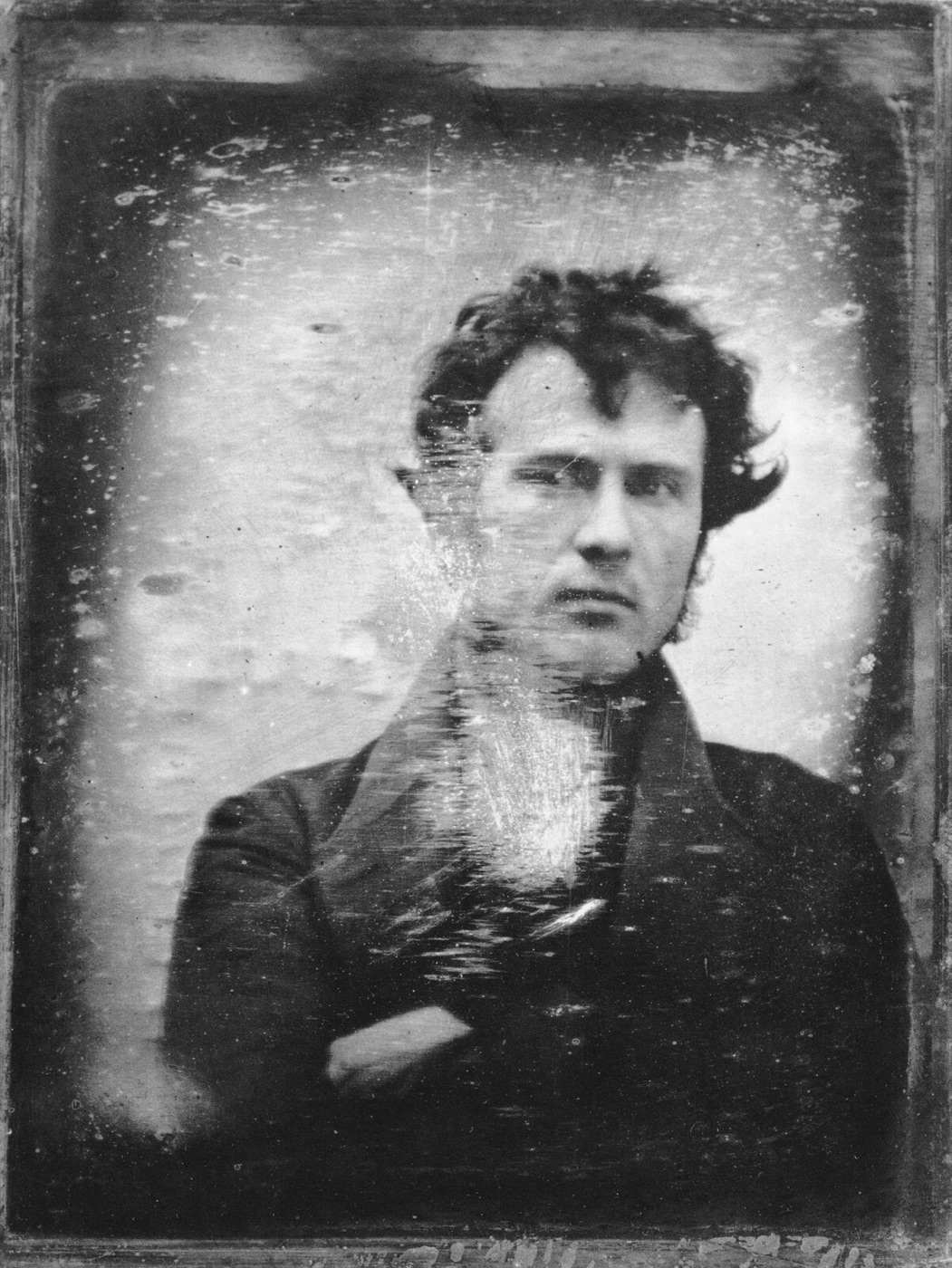
Bottom line: 1839 is not the year of the first photograph but the year a way of taking photographs was first made public for anyone to learn. Niépce left us the oldest photograph; Daguerre brought photography out of the laboratory.
Sources
- Wikipedia, "Daguerreotype". https://en.wikipedia.org/wiki/Daguerreotype
- City of Paris, « Un détail imprévu » fait revivre un cliché historique, 2026-10-15. https://www.paris.fr/pages/un-detail-imprevu-fait-revivre-un-cliche-historique-36437
- Wikipedia, "Louis Daguerre". https://en.wikipedia.org/wiki/Louis_Daguerre
- Wikipedia, "Diorama". https://en.wikipedia.org/wiki/Diorama
- Swiss Camera Museum, Parisian opticians Chevalier. https://www.cameramuseum.ch/en/discover/permanent-exhibition/the-origins-of-photography/parisian-opticians-chevalier/
- Wikipedia, "Boulevard du Temple (photograph)". https://en.wikipedia.org/wiki/Boulevard_du_Temple_(photograph)
- R. Derek Wood, "A State Pension for L. J. M. Daguerre for the Secret of his Daguerreotype Technique", Annals of Science 54 (1997) 489–506. https://web.archive.org/web/20070401194154/http://www.midley.co.uk/Pension/Pension.htm
- Oliver Wendell Holmes, "The Stereoscope and the Stereograph", The Atlantic Monthly, June 1859.
- Wikipedia, "Robert Cornelius". https://en.wikipedia.org/wiki/Robert_Cornelius
- Wikipedia, "Petzval lens". https://en.wikipedia.org/wiki/Petzval_lens
Compiled by photographer and photography lecturer Travis Zhang from the course script; every fact is checked against the sources.