
From the Pinhole · Lesson 10
When could you put the tripod away? The gelatin dry plate and the "instantaneous" photograph
The text version of a lesson from Photography with Travis Zhang. All lessons →
In short: from the 1880s. In 1871 the English doctor Richard Leach Maddox published a gelatin silver bromide dry plate, but it was slower than wet collodion; only after Charles Bennett "ripened" the emulsion by keeping it warm for days in 1878 did dry plates become fast, four or five times faster than wet plates by contemporary accounts. Around 1880 studios switched to dry plates, shutters caught up, cameras shrank, and by 1883 a patent described a camera meant to be held in the hand.
Could wet plates really not capture movement?
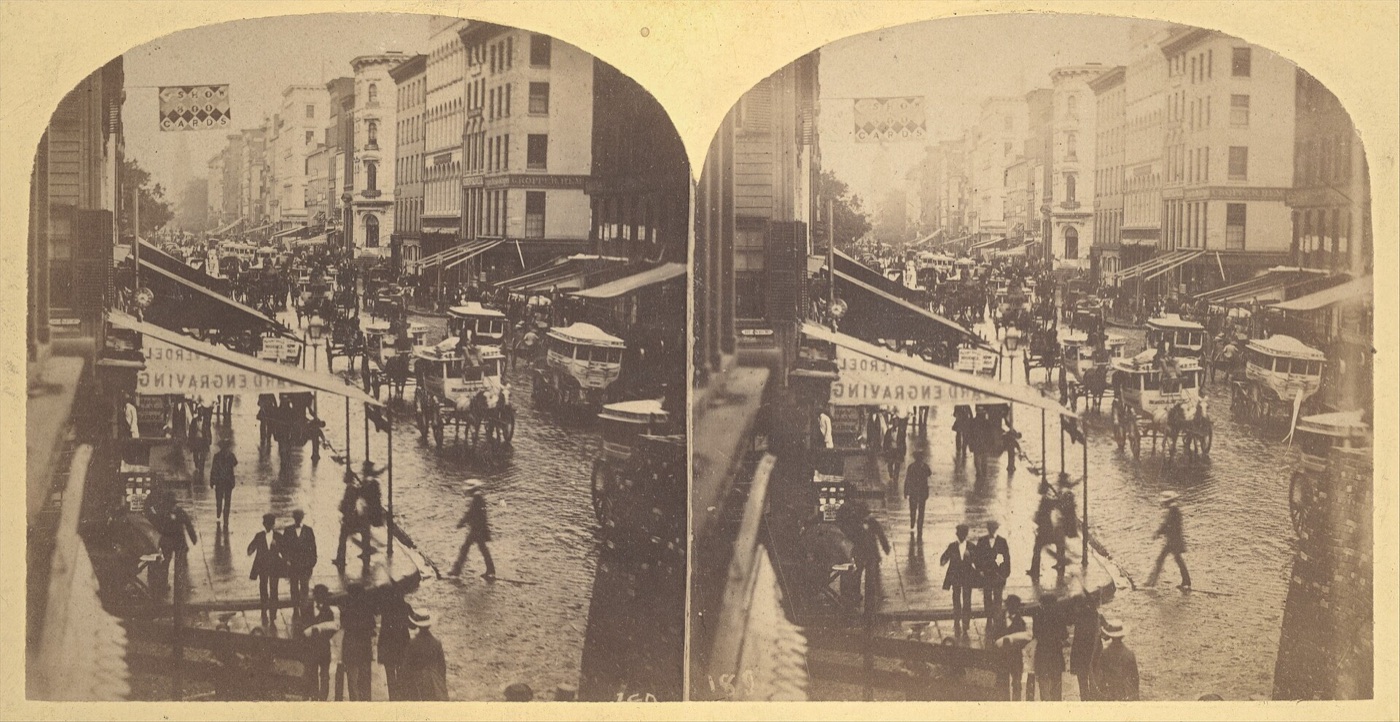
Not quite. In 1859 the Anthony brothers of New York (E. & H. T. Anthony) made wet-plate stereographs of Broadway on a rainy day in which most of the umbrella-carrying crowds and carriages show no blur; they called them "instantaneous" views.[1] They relied on small cameras and plates, short lenses, more sensitive collodion and faster shutters, shooting from a second floor at a distance. But that was a few experts in the right conditions; for most photographers, wet plates had to be coated, exposed and developed on the spot, and a studio portrait took a few seconds to a dozen or more.
Who invented the gelatin dry plate?
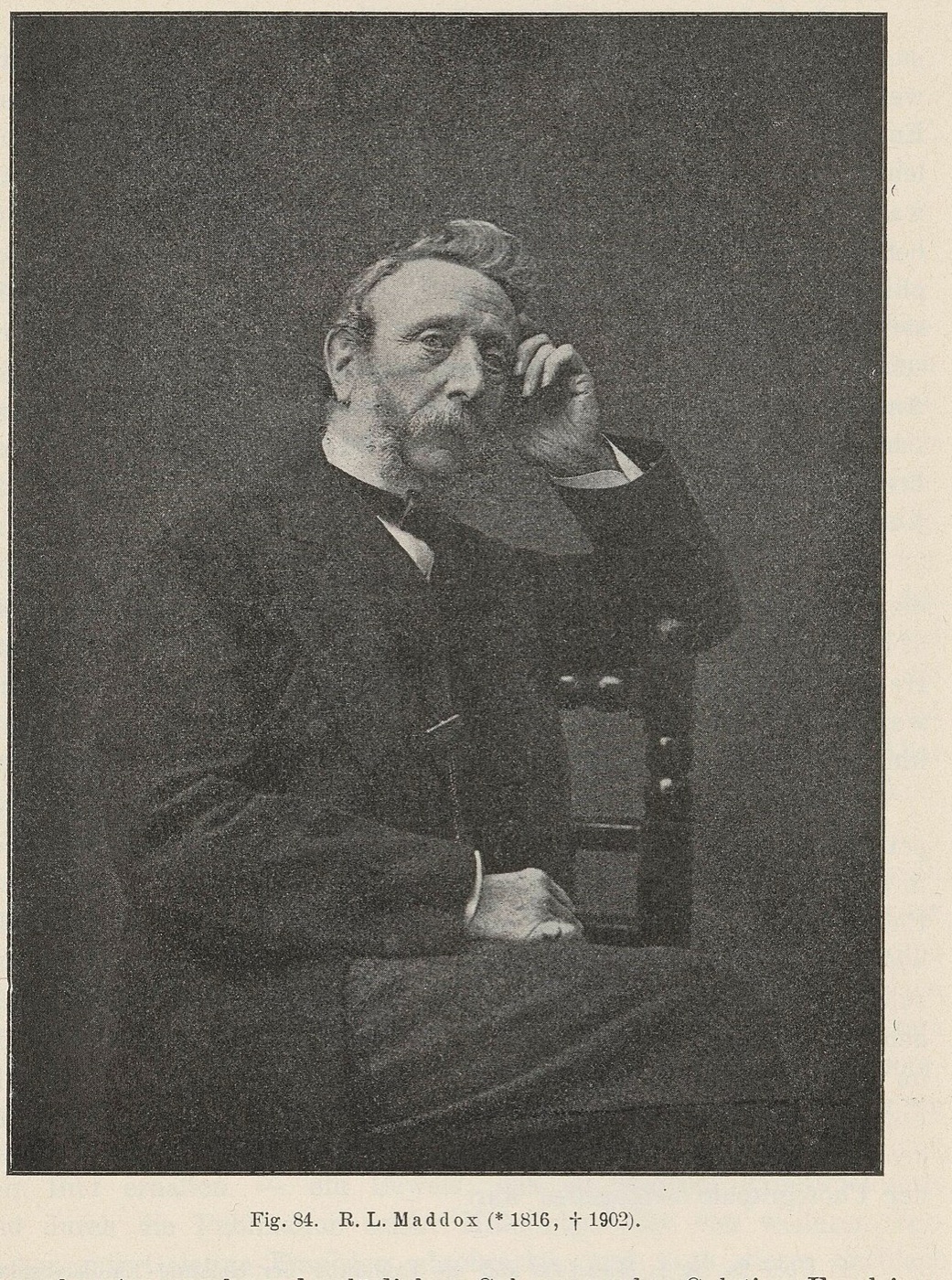
The English doctor Richard Leach Maddox, who published "An Experiment with Gelatino-Bromide" in The British Journal of Photography on 8 September 1871.[2] He made photomicrographs in a dressing room used as a darkroom, and collodion fumes left him waking at night still tasting them, so he tried gelatin instead.[3] He mixed bromide and silver nitrate into warm gelatin, coated glass and let it dry: the plate no longer had to be used wet. He took no patent and gave it to the public; poor in old age, he received a fund raised by photographers in several countries.[3][4]
Why didn't Maddox's plate replace wet collodion at once?
Because it was slower than wet collodion. His article mentions the lack of sensitivity more than once, and his 1887 letter is blunter: compared with collodion, gelatin was slower.[2][3] In the following years J. Burgess in London sold a gelatin emulsion that did not keep, and Richard Kennett patented a dried emulsion "pellicle" in 1873 and sold ready-coated plates the next year, mainly to amateurs; studios hardly used them.[4][5]
How did dry plates get faster?
Through ripening. On 29 March 1878 Charles Bennett described in the same journal how he kept the emulsion at 90 °F (about 32 °C) for two, four or seven days: the longer, the faster.[6] A week earlier the journal had described one of his negatives, boats on a river, taken with a drop shutter at about a twentieth of a second. The 1911 Encyclopædia Britannica says the rapid dry plate dates from 1878 and the credit belongs entirely to Bennett.[6][7]
How much faster than wet plates were dry plates?
Four or five times faster, by contemporary accounts, not dozens of times. The plate dealer John Werge recalled a trial at Elliott & Fry's London studio in November 1878: their wet plate needed 90 seconds; he said 20 seconds would do for his dry plate, the assistant counted two or three seconds too many, and the result was slightly overexposed. That story rests on Werge alone.[5] German and Dutch makers at the time also spoke of "four times". The "60 times faster" figure seen online has no source we could find.[4]
What did dry plates change for photographers?
They no longer had to carry a darkroom. Dry plates could be bought ready-made, kept for weeks or even months before use, and developed later.[8] Mass production began in Britain around 1878, and studios widely switched around 1880.[5][4] Two dry-plate makers went on to change photography:
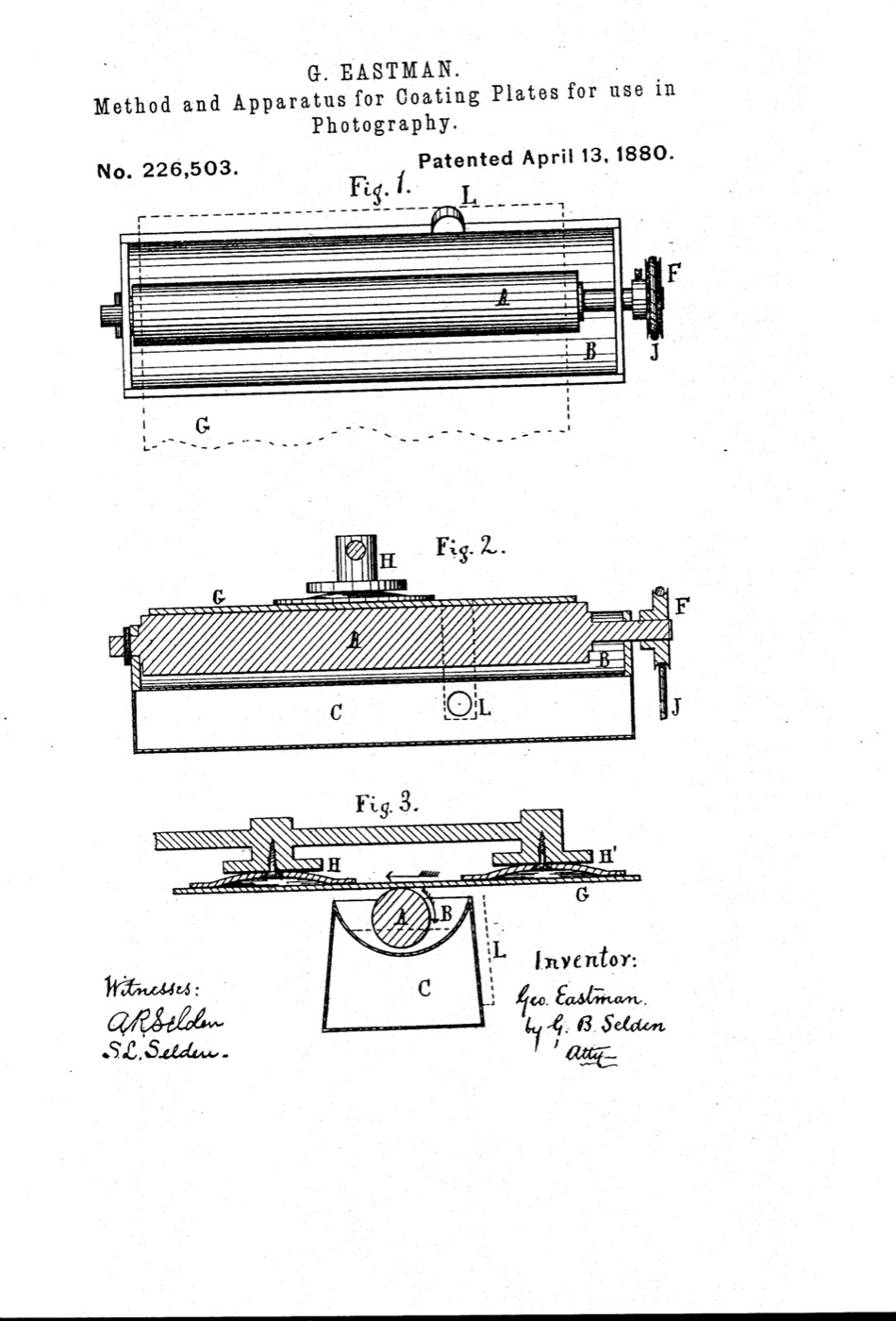
- George Eastman, a bank clerk in Rochester, New York, built a plate-coating machine, received US Patent 226,503 in 1880, and on 1 January 1881 founded the Eastman Dry Plate Company with Henry A. Strong, the forerunner of Kodak.[9][10]
- The Lumière family of Lyon bought an old hat factory in 1881, turned it into a dry-plate works, grew rich on it, and later brought out colour plates and a cinema projector.[11][12]
When did hand-held cameras appear?
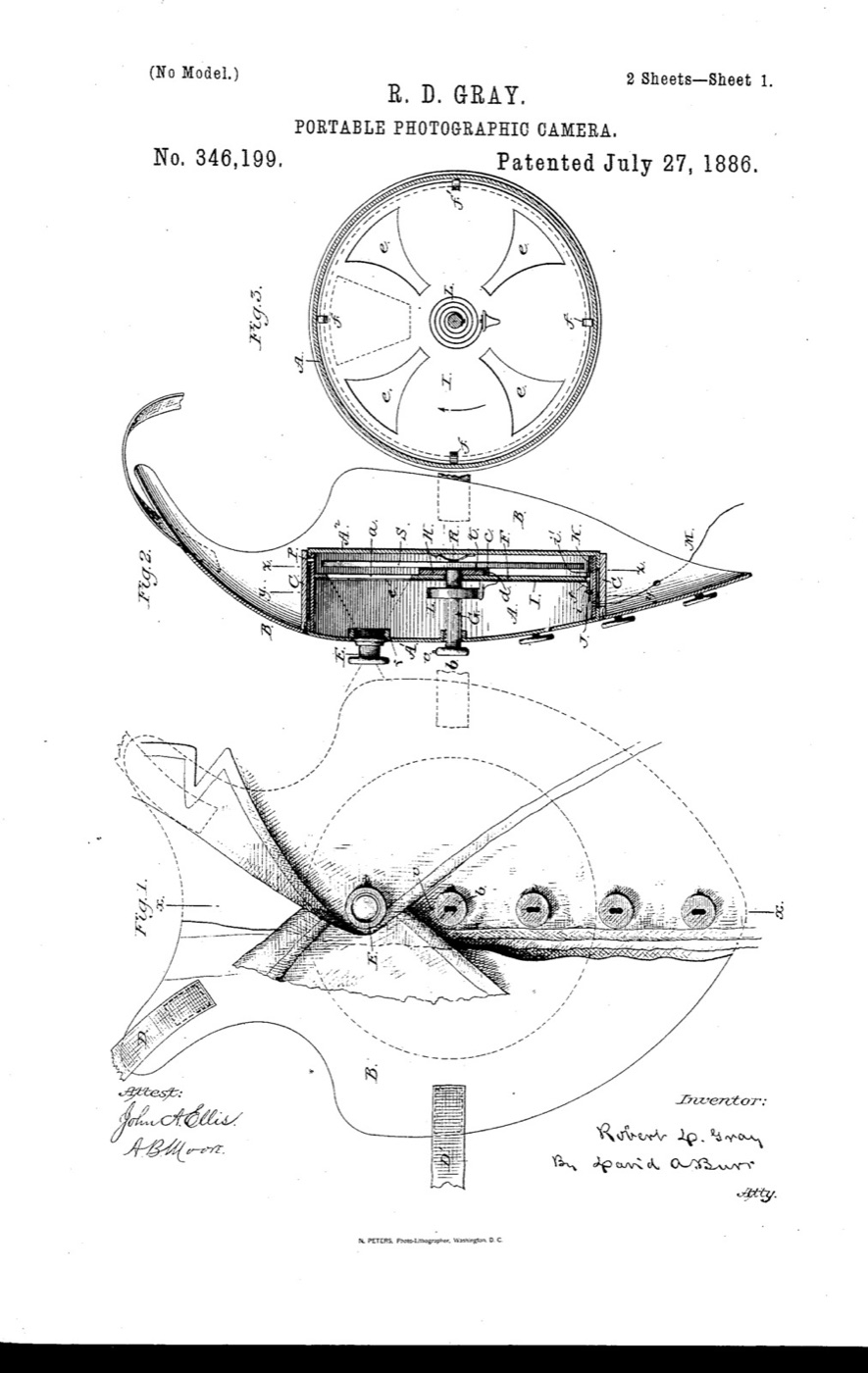
In 1883, when William Schmid's US camera patent stated that the photographer could hold it in the hand or under the arm.[13] These inconspicuous tripod-free cameras were called "detective cameras"; later ones hid under a waistcoat with the lens poking through a buttonhole (1886) or were disguised as books (1888).[14][15] Taking a lens cap off and on was now too slow, so mechanical shutters became essential.
Why did early dry plates render red badly?
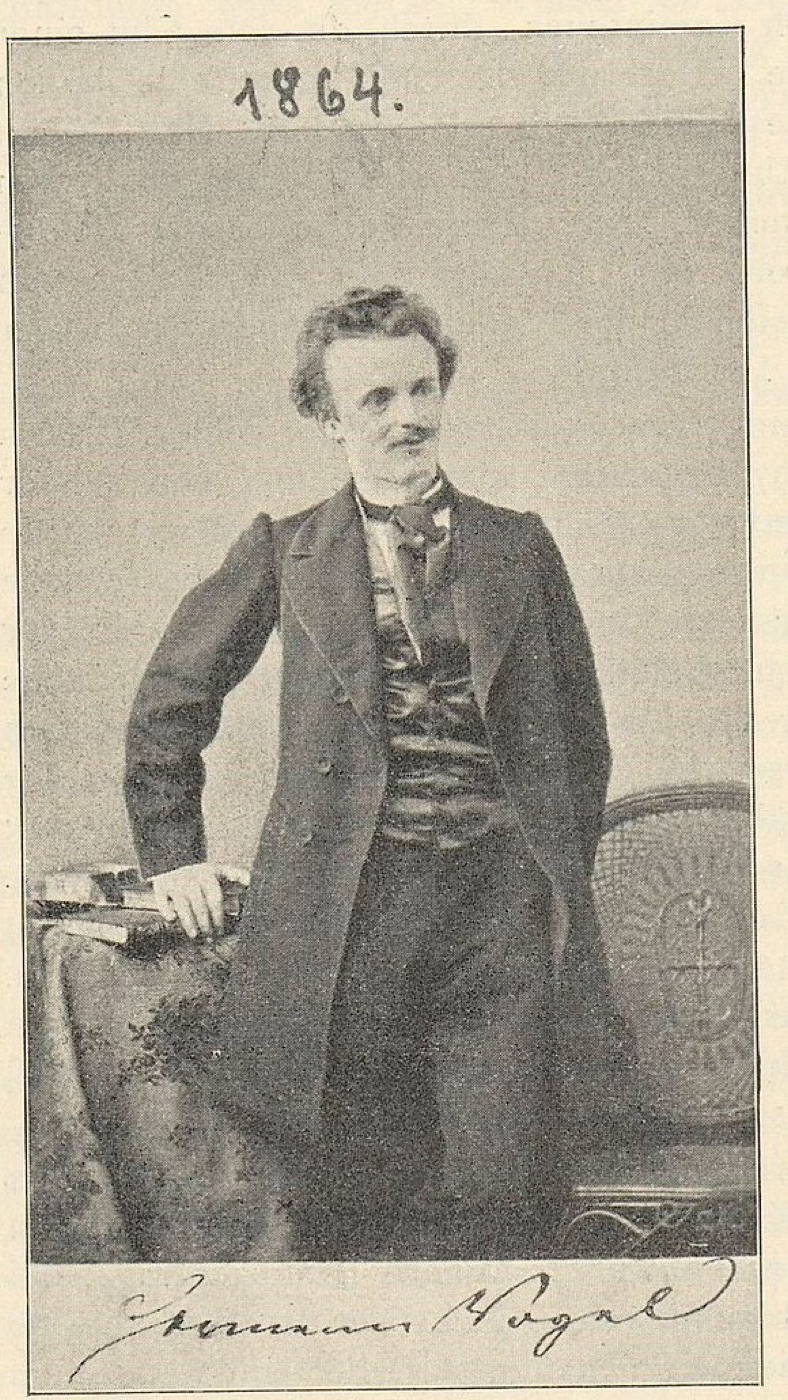
Because they were sensitive mainly to blue and violet light, so blue skies came out white and reds and yellows dark. In 1873 the German chemist Hermann Wilhelm Vogel found that a dye added to a collodion dry plate made it more sensitive to green: dye sensitisation.[4][16] Orthochromatic gelatin plates, sensitive to green and yellow too, reached the market in the 1880s, and panchromatic plates followed in the early twentieth century.[4]
How is film related to the dry plate?
Film uses the same gelatin emulsion. By 1881 someone in Paris was already coating gelatin silver bromide onto celluloid, and a few years later light, rollable film appeared.[4] To this day, the light-sensitive part of film is the silver salts; the gelatin is the layer that holds them in place.
Bottom line: the gelatin dry plate began slower than wet collodion and became fast only after Bennett's ripening in 1878; by the 1880s dry plates, shutters and small cameras together let people hold a camera in their hands and take a picture with one press.
Sources
- The Metropolitan Museum of Art, E. & H. T. Anthony, instantaneous stereograph (1859), 1980.1056.1. https://www.metmuseum.org/art/collection/search/262760
- R. L. Maddox, "An Experiment with Gelatino-Bromide", The British Journal of Photography 18 (8 September 1871): 422–423; reprinted in full in the obituary in The British Journal Photographic Almanac (1903). https://archive.org/details/britishjournalph1903unse
- R. L. Maddox, letter to W. Jerome Harrison (19 August 1887), in "The Origin of the Gelatino-Bromide Process", The British Journal of Photography 34 (4 November 1887). https://archive.org/details/britishjournalof34unse
- Josef Maria Eder, History of Photography, trans. Edward Epstean (New York: Columbia University Press, 1945). https://archive.org/details/EderHistoryPhotography
- John Werge, The Evolution of Photography (London, 1890). https://www.gutenberg.org/ebooks/38866
- Charles Bennett, "A Sensitive Gelatine Emulsion Process", The British Journal of Photography 25 (29 March 1878): 146–147; and notes of 22 March and 17 May 1878. https://archive.org/details/britishjournalof25unse
- Encyclopædia Britannica, 11th ed. (1911), "Photography". https://en.wikisource.org/wiki/Page:EB1911_-_Volume_21.djvu/515
- Science and Media Museum Blog, "A brief guide to photographs on glass" (2010). https://blog.scienceandmediamuseum.org.uk/a-brief-guide-to-photographs-on-glass
- George Eastman, US Patent 226,503, "Method and Apparatus for Coating Plates for Use in Photography" (1880). https://patents.google.com/patent/US226503A/en
- American Chemical Society, National Historic Chemical Landmark: "Eastman Kodak". https://www.acs.org/education/whatischemistry/landmarks/eastman-kodak.html
- Ministère de la Culture, Mérimée PA00118154, "Hangar du Premier-Film". https://pop.culture.gouv.fr/notice/merimee/PA00118154
- Institut Lumière, "The Lumière villa". https://www.institut-lumiere.org/musee/discover-the-lumiere-site/the-lumiere-villa-english.html
- William Schmid, US Patent 270,133, "Photographic Camera" (1883). https://patents.google.com/patent/US270133A/en
- Robert D. Gray, US Patent 346,199, "Photographic Camera" (1886). https://patents.google.com/patent/US346199A/en
- Victoria and Albert Museum, "The unusual cameras of the Royal Photographic Society Collection". https://www.vam.ac.uk/blog/caring-for-our-collections/the-unusual-cameras-of-the-royal-photographic-society-collection
- H. W. Vogel, "Ueber die Lichtempfindlichkeit des Bromsilbers für die sogenannten chemisch unwirksamen Farben", Berichte der deutschen chemischen Gesellschaft 6 (1873): 1302–1306. https://doi.org/10.1002/cber.187300602130
Compiled by photographer and photography lecturer Travis Zhang from the course script; every fact is checked against the sources.