
From the Pinhole · Lesson 13
What did a one-dollar camera change?
The text version of a lesson from Photography with Travis Zhang. All lessons →
In short: it changed who took the pictures and what got photographed. In 1900 Kodak launched the Brownie: a camera for 1 dollar, a roll of film for 15 cents, six pictures to a roll, and an advertisement promising that any schoolboy or schoolgirl could work it. Within a year it had sold more than 100,000. Photographers were no longer just adults in studios but children, women and ordinary wage earners, and what they shot was the casual snapshot, not the sit-still portrait. The 120 film that arrived with the No. 2 Brownie in 1901 is still being made today.
When did the Brownie appear, and how could it be so cheap?
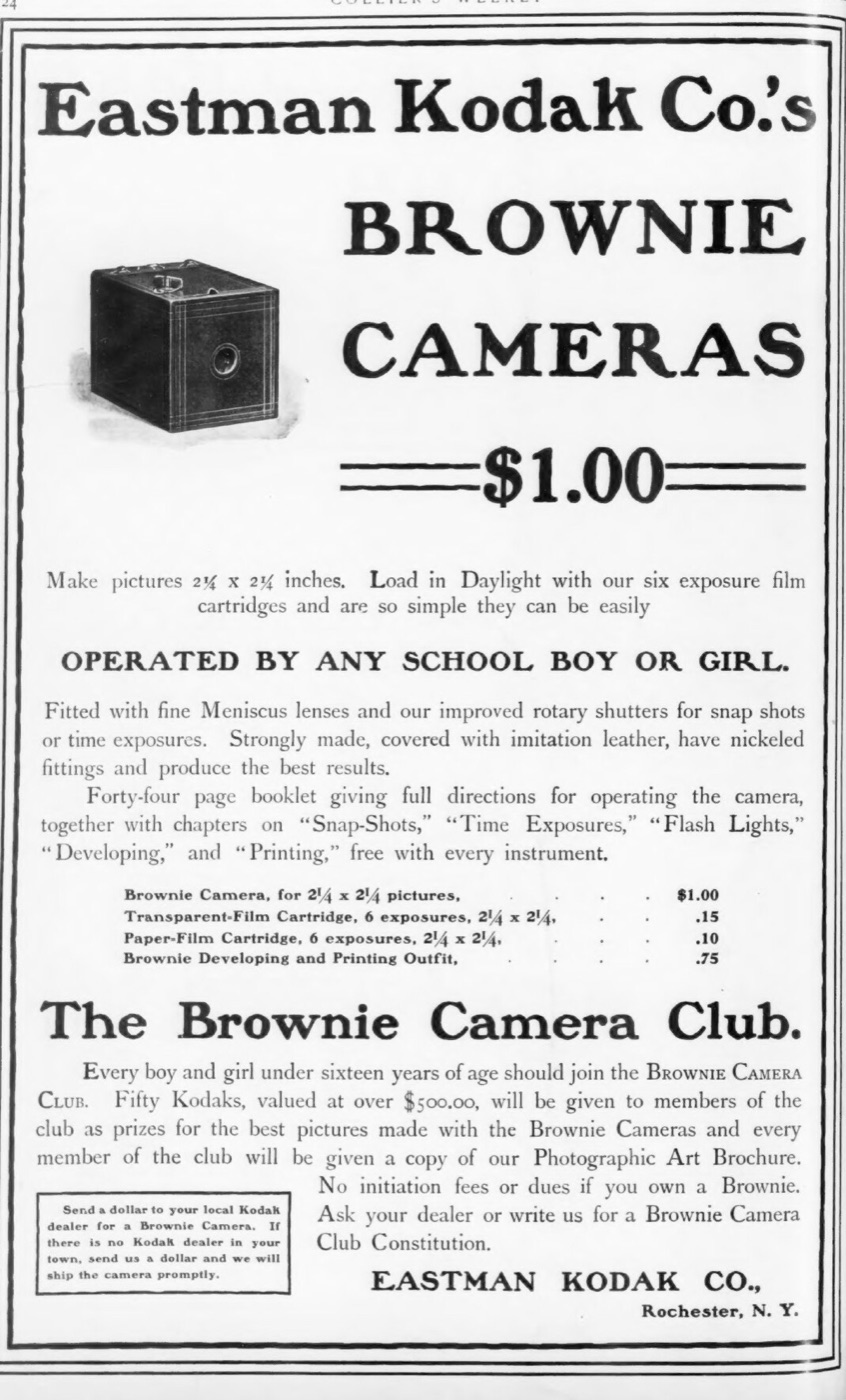
It went on sale in 1900 for one dollar; the Kodak of 1888 had cost 25. Eastman wrote in a Kodak trade publication that he wanted every schoolboy, schoolgirl and wage earner to be a Kodaker, so he asked the camera maker Frank Brownell for a design as cheap as possible that still took good pictures.[1][2] The result was a small box about 12 centimetres long: cardboard reinforced with wood strips, covered in imitation leather, with a single simple lens and a rotary shutter. The earliest ones had no viewfinder, only sighting lines drawn on top. The film loaded in daylight, the negatives were square, about 5.7 centimetres a side, and a roll of six cost 15 cents.[3][4]
Why is it called the "Brownie"?
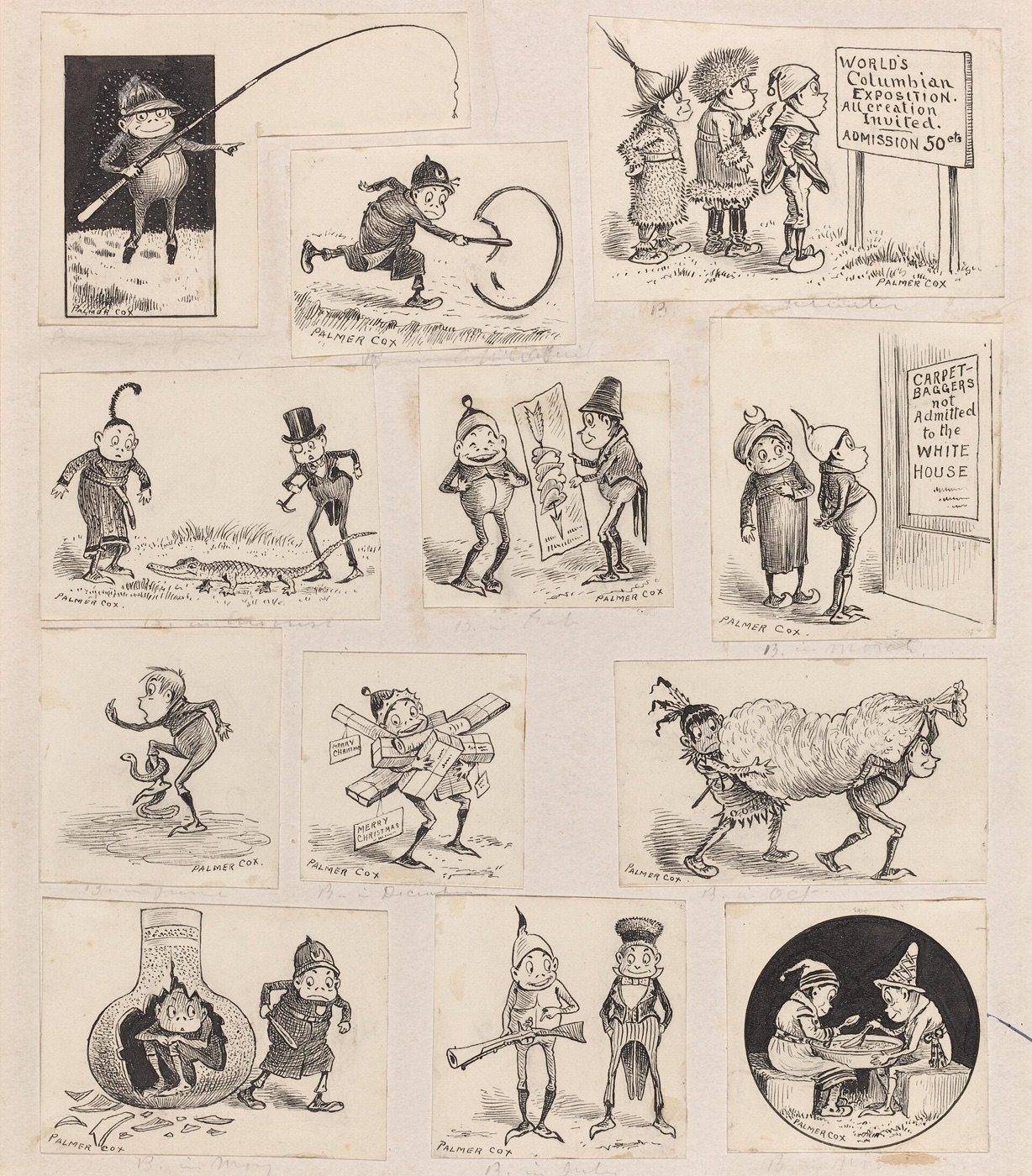
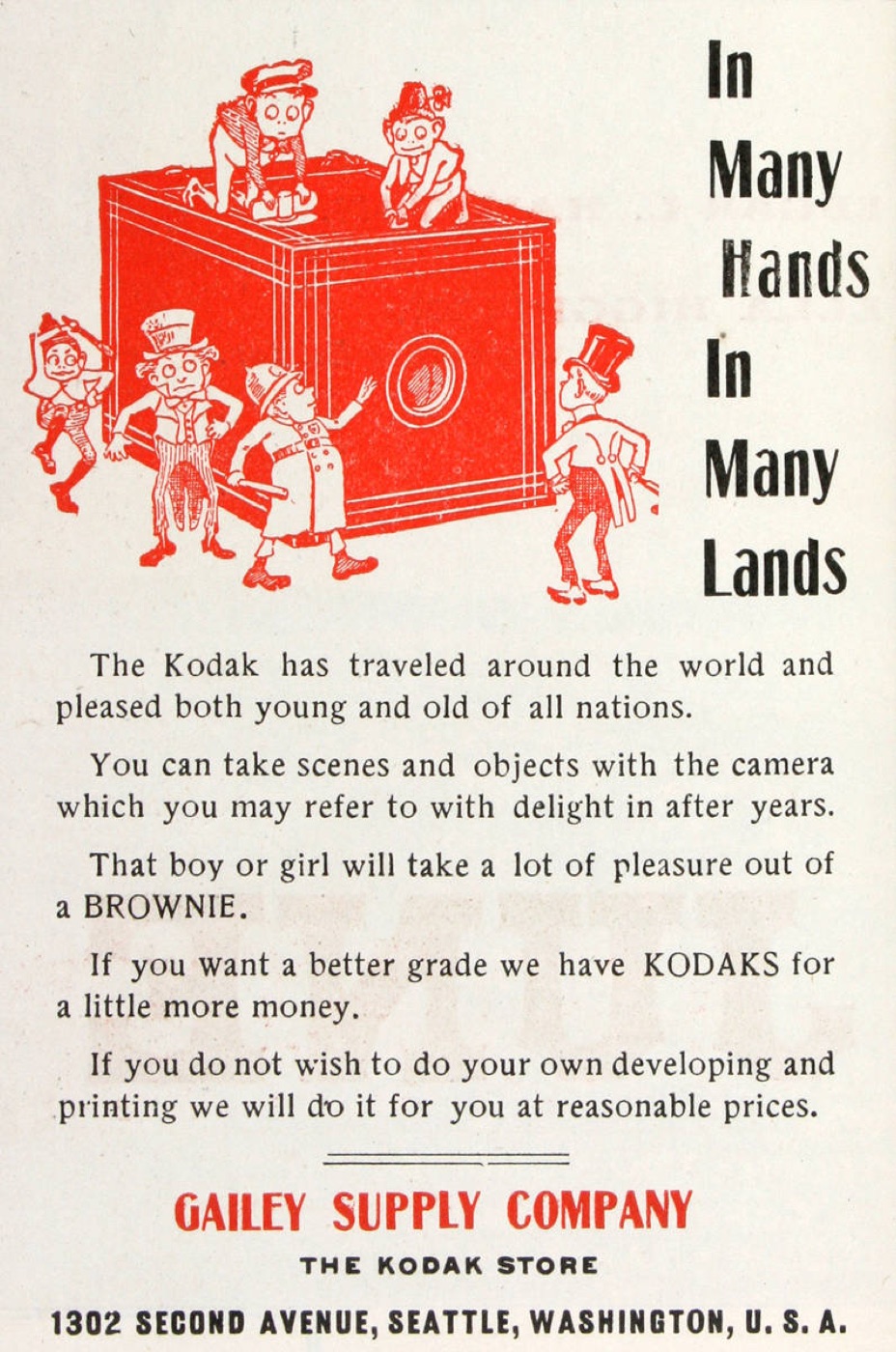
The name came from a band of little elves, not from Frank Brownell, as the National Science and Media Museum states explicitly.[2] In folklore a brownie is a helpful elf who secretly does people's housework. From the early 1880s the Canadian artist Palmer Cox drew elves called Brownies in American children's magazines, later collected in more than a dozen books.[5] They were pictured on the packaging and in early advertising; the 1900 advertisement promised "operated by any school boy or girl".[3] Adults soon turned out to be buying the camera too, the elves disappeared from the box, and the name stayed.
How well did it sell, and who bought it?
More than 100,000 were sold within a year, nearly half of them in Britain, where it cost 5 shillings.[6][2] A curator at the George Eastman Museum writes that more than 150,000 shipped in the first year, when Kodak's biggest single-year output until then had been 55,000 cameras.[7] Shipped means sent to dealers and sold means in a customer's hands, so the figures do not contradict each other. The popular "10 million in five years" has no source that I could find.[8]
The buyers changed too. The historian Brian Coe worked out that in 1910 a 2-dollar No. 2 Brownie cost about 35% of a Kodak factory worker's average weekly wage, in 1920 about 20%, and by 1930 only about 15%.[6] He also wrote that simple cameras plus developing and printing services drew large numbers of women into photography; on a 1903 photographic outing to Wembley Park in London more than a third of the participants were women.[6]
How were Brownie pictures different from studio portraits?
They were not posed and did not wait for good light, which is what we call a snapshot. Coe writes that snapshots were taken on impulse, almost at random; precisely because of that, they gave later generations, for the first time, a glimpse of how ordinary people lived.[6] The negative of the original Brownie was printed in contact with the paper, so the print was as big as the negative, often just 5.7 centimetres square. Shops would develop the film for you, and in the 1920s Kodak advertising urged parents to keep "a Kodak story of the children".[9] A family album is built up exactly like that, one picture after another.
Where did the No. 2 Brownie and 120 film come from?
In 1901 Kodak brought out the No. 2 Brownie, 2 dollars, with a rectangular negative about 6 by 9 centimetres, still six pictures to a roll; the original became the No. 1 Brownie.[6][10] Around 1913 Kodak numbered its roll films: the No. 1 Brownie took 117, the No. 2 took 120.[11] The 117 was discontinued in 1949; 120 is still made.
What are the paper strip and the little red window for?
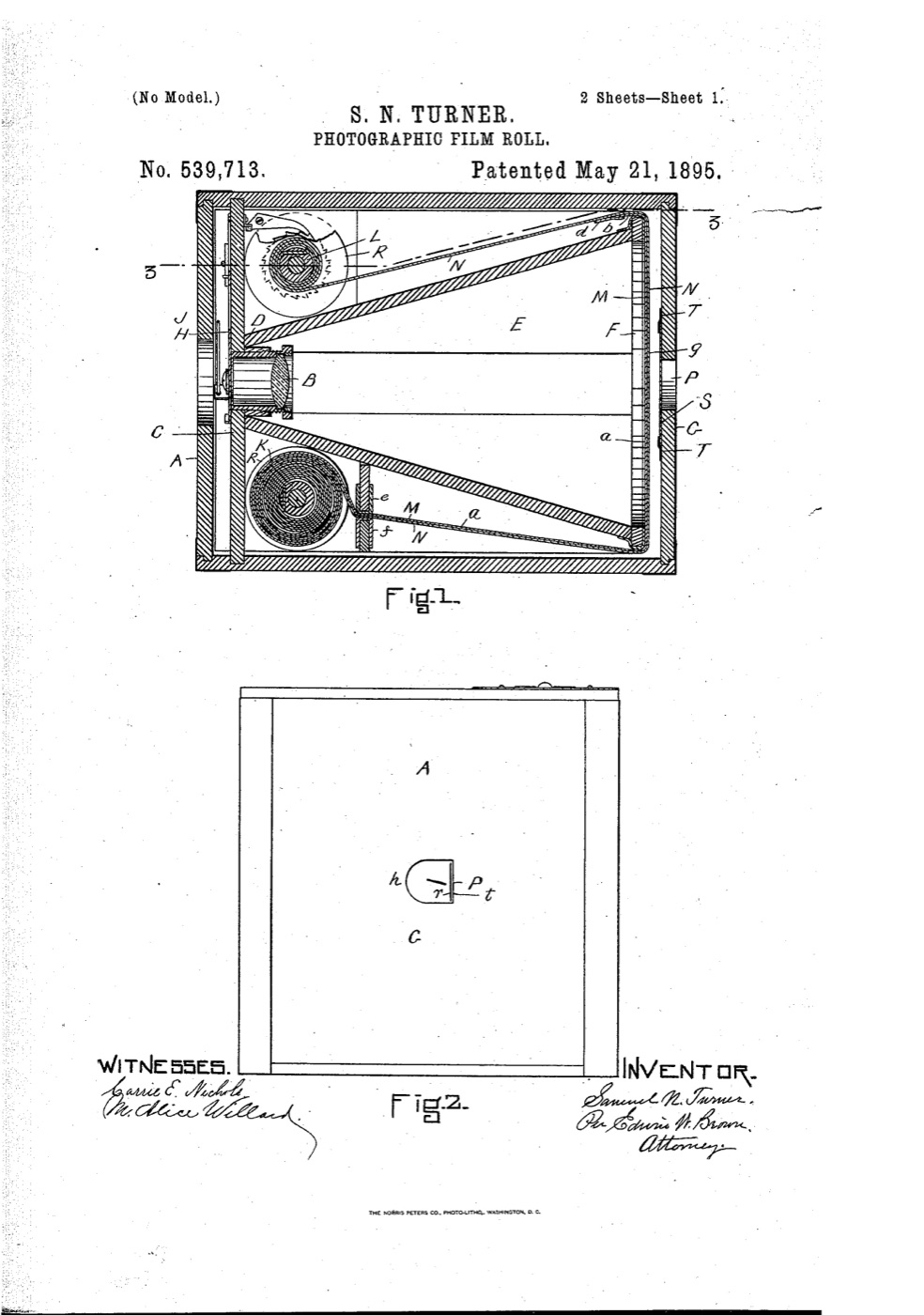
They let you load film in daylight and know which frame you were on. A 120 roll has a longer strip of backing paper stuck to the back of the film and wound on the spool with it; the paper blocks the light, so no darkroom is needed. The outer side is printed with numbers, and a small red window in the camera back shows them: after each shot you wind on until the next number appears.[12] The window was red because films of the time were not sensitive to red light.[13] The idea came from Samuel Turner of a Boston camera company, who applied for a patent in 1892 and was granted it in 1895, the year Eastman bought the firm.[14][6]
How many pictures are on a roll of 120?
It depends on the frame size. The film is about 6 centimetres wide, so one side of the frame is always roughly 6 centimetres, and the other can be longer or shorter. Today's 120 is longer than in 1901, when a roll gave six pictures: 6 by 9 gives 8 frames, 6 by 6 gives 12, 6 by 4.5 gives 15 or 16, and 6 by 7 gives 10.[15][16] A 6 by 6 frame has more than three times the area of a 35mm frame and enlarges with finer grain; cameras that use 120 are called medium format.
Why were there 127 and 620 as well, and why did only 120 survive?
Cameras for 127 and 620 went out of production, and in the end the standard kept only 120 and 220. In 1912 Kodak launched a small camera that fitted a waistcoat pocket and used the narrower 127 film, with a negative about 4 by 6.4 centimetres; in the First World War Kodak advertised it as "The Soldier's Kodak".[17] In 1932 came 620: film as wide as 120 on a thinner spool, and the two spools are not interchangeable.[11] Kodak stopped making 127 and 620 in 1995. The 1991 revision of the international standard says cameras for 127 and 620 had ceased to be made, demand was very small and falling, and new automatic film-metering cameras used 120 and a 220 twice as long with no backing paper.[15] It gives the result, not the reason. The Pentax 67 and Mamiya 645 medium-format cameras all use 120.
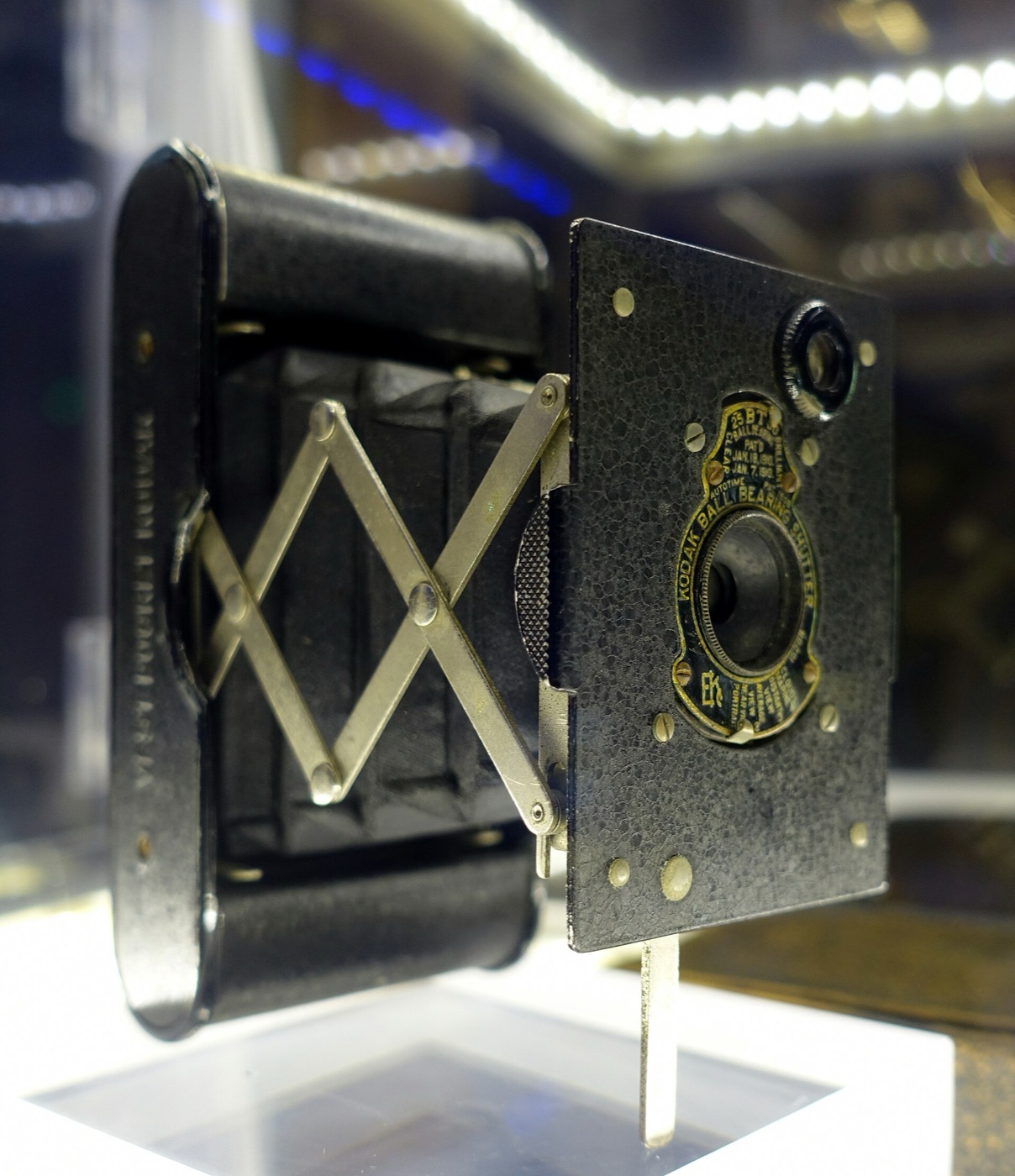
So what did the one-dollar camera change?
It changed who took the pictures: children, women and ordinary wage earners now had a camera of their own. It changed what was photographed: not just the formal portrait in the studio but the yard, the beach and the dinner table. It changed what a photograph was for: from one picture on the wall to a long run of days in an album. And it left behind a roll of film: the 120 of 1901.
Bottom line: the one-dollar camera did not invent the snapshot, since the Kodak of 1888 already made them; it widened the road. The pictures you take on a whim with your phone travel along it.
Sources
- Carl W. Ackerman, George Eastman (Boston: Houghton Mifflin, 1930), pp. 59–60, 169–171, 242–243. https://archive.org/details/georgeeastman00acke_0
- Colin Harding, "A–Z of the photography collection: B is for Brownie", National Science and Media Museum blog, 26 October 2012. https://blog.scienceandmediamuseum.org.uk/a-z-photography-collection-b-is-for-brownie
- Eastman Kodak Co., Brownie camera advertisement, Collier's Weekly 25, no. 7 (19 May 1900). https://archive.org/details/sim_colliers-the-national-weekly_1900-05-19_25_7
- Science Museum Group, "The Brownie camera" (original model, box camera for 117 roll film), object co8083829. https://collection.sciencemuseumgroup.org.uk/objects/co8083829/the-brownie-camera
- The Canadian Encyclopedia, "Palmer Cox". https://www.thecanadianencyclopedia.ca/en/article/palmer-cox
- Brian Coe and Paul Gates, The Snapshot Photograph: The Rise of Popular Photography, 1888–1939 (London: Ash & Grant, 1977), pp. 18, 23, 28, 40, 139. https://archive.org/details/snapshotphotogra0000coeb
- Todd Gustavson (George Eastman Museum), "Camera History 1900 to 1940", in A Century of Optics (Optica), pre-1940 section, no. 31. https://opticaorgdev.blob.core.windows.net/$web/optica/media/osa.history/century_of_optics/pre-1940/31.pdf
- Eric Schewe, "How the Brownie Camera Made Everyone a Photographer", JSTOR Daily, 26 December 2018 (gives the "10 million in five years" figure without a source). https://daily.jstor.org/how-the-brownie-camera-made-everyone-a-photographer
- Kodak advertisement "Keep a Kodak story of the children", Maclean's Magazine, 1 August 1921 (also July 1921, May 1923, May 1924). https://archive.org/details/Macleans-Magazine-1921-08-01
- Eastman Kodak Co., Taking Pictures with the Brownie Camera No. 2 (pamphlet, c. 1901). https://archive.org/details/brownie-no-2-pamphlet
- "History of Kodak Roll Film Numbers" (collector's table compiled from Kodak sources). https://bvipirate.com/Kodak/FilmHist.html
- Canadian Kodak Co., Picture Taking with the Brownie Camera No. 2 (Toronto, August 1918). https://archive.org/details/picturebrownie00ckcuoft
- Photographic Historical Society of Canada, "Ruby red window", 13 August 2020. https://phsc.ca/camera/ruby-red-window/
- Samuel N. Turner, US Patent 539,713, "Photographic film-roll" (filed 21 April 1892, granted 21 May 1895). https://patents.google.com/patent/US539713A/en
- ISO 732:1982, Photography — Dimensions for 127, 120 and 620 roll film, backing paper and film spools; ISO 732:1991, Photography — Film dimensions — 120 and 220 sizes, introduction and figure 1 (public preview pages). https://cdn.standards.iteh.ai/samples/4979/39f3b8b929814e73845f693435fc2b2d/ISO-732-1982.pdf ; https://cdn.standards.iteh.ai/samples/4980/3872311b772d4336a80de0ec18b072f4/ISO-732-1991.pdf
- Ricoh Imaging, "Medium-Format SLR Camera: 67II — Specifications". https://www.ricoh-imaging.co.jp/english/products/filmcamera/medium/672/spec.html
- Colin Harding, "The Vest Pocket Kodak was the soldier's camera", National Science and Media Museum blog, 13 March 2014. https://blog.scienceandmediamuseum.org.uk/the-vest-pocket-kodak-was-the-soldiers-camera
Compiled by photographer and photography lecturer Travis Zhang from the course script; every fact is checked against the sources.