
From the Pinhole · Lesson 3
Why did the first photograph take hours to expose? Niépce and heliography
The text version of a lesson from Photography with Travis Zhang. All lessons →
In short: because its light-sensitive material was bitumen, which reacts to light extremely weakly. In 1827 the Frenchman Nicéphore Niépce made View from the Window at Le Gras from an upstairs room of his country house, on a pewter plate coated with bitumen of Judea; it is the oldest surviving photograph taken with a camera. Bitumen needs a great deal of light to harden, and the light inside a camera obscura is far weaker than direct sun. The old figure was about 8 hours; later reconstructions suggest it more likely took several days.
What is the first photograph in the world?
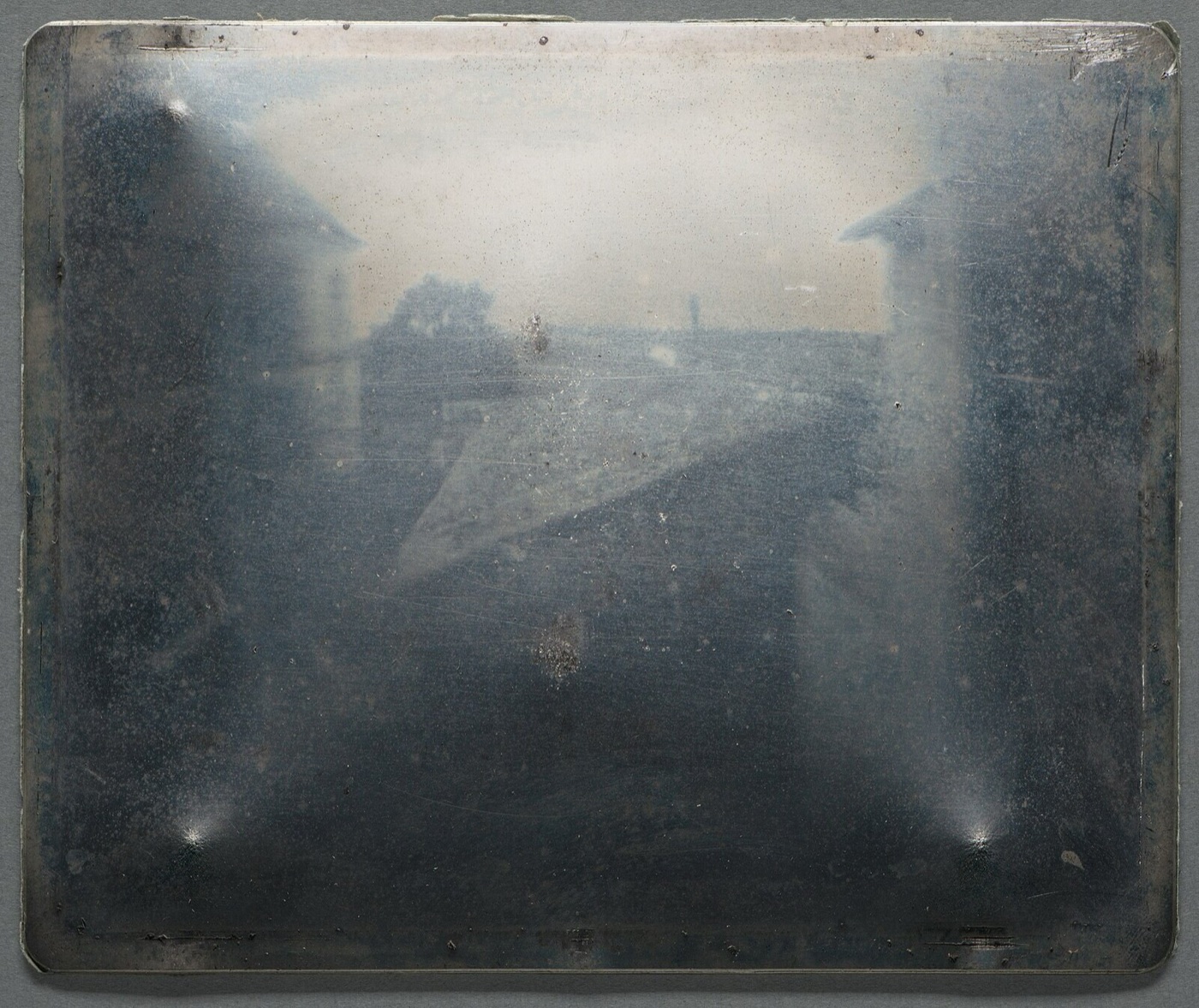
It is Niépce's View from the Window at Le Gras, held by the Harry Ransom Center at the University of Texas, the oldest surviving photograph taken with a camera.[1] In 1827, in an upstairs room at his estate of Le Gras, he pointed a camera obscura out of the window, and the plate recorded a pigeon house, a pear tree, the slanted roof of a barn and the side of the bakehouse.[2] The plate measures about 16 × 20 cm, roughly the size of an A5 sheet[3]; analysis by the Getty showed it is pewter, mainly tin with lead.[4] There is no negative and only this one plate exists. To see the image you have to tilt it against the light.
Why had no one managed to keep an image before Niépce?
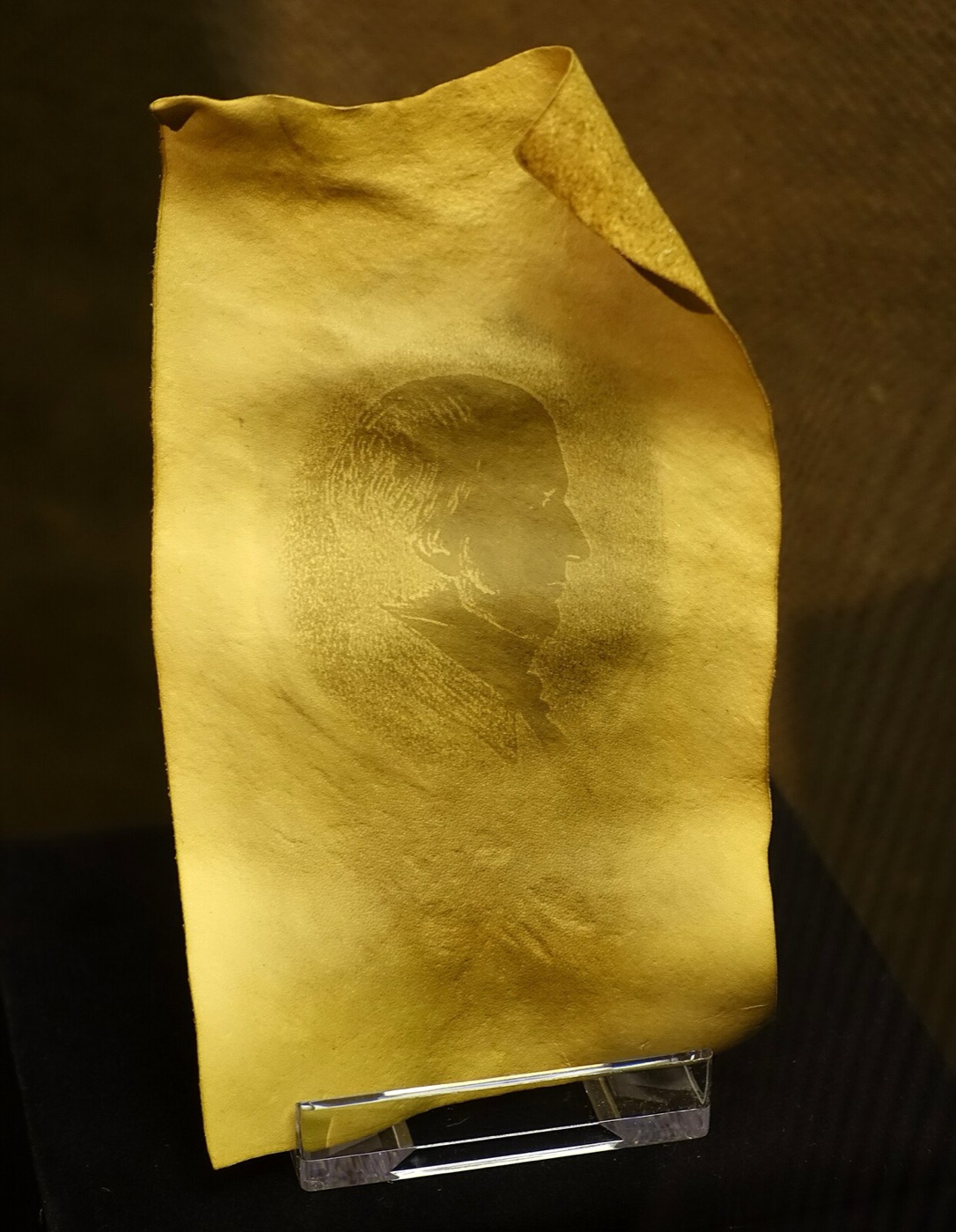
Because the materials people found could only darken; they could not be made permanent. It was long known that some silver compounds darken in light.[5] In 1802 the chemist Humphry Davy published Thomas Wedgwood's method: coat paper or leather with silver nitrate, lay a leaf on it and let the sun print its shadow. But brought into the light, the whole sheet turned dark, so it could only be kept in the dark and looked at now and then; and the light in a camera obscura was too weak to show any change in a short time.[6]
In 1816 Niépce also captured the view from his window on silver-salt paper in a camera obscura, but he got a negative, and it too darkened all over in daylight.[7]
What is heliography?
It is Niépce's process for making images with bitumen, which hardens when exposed to light; the French héliographie means "sun writing".[1] The steps:
- Dissolve bitumen of Judea, from around the Dead Sea, in oil of lavender, and spread a thin coat on a metal or glass plate, then dry it[8][9];
- During exposure, the parts struck by light harden and no longer dissolve;
- Wash the plate with 1 part oil of lavender to 10 parts refined white petroleum, which removes the soft bitumen.[9]
Light areas keep pale bitumen, dark areas expose bare metal, which reflects dark surroundings and looks black, so the result is a positive.[8]
Why is it sometimes called "sun engraving"?
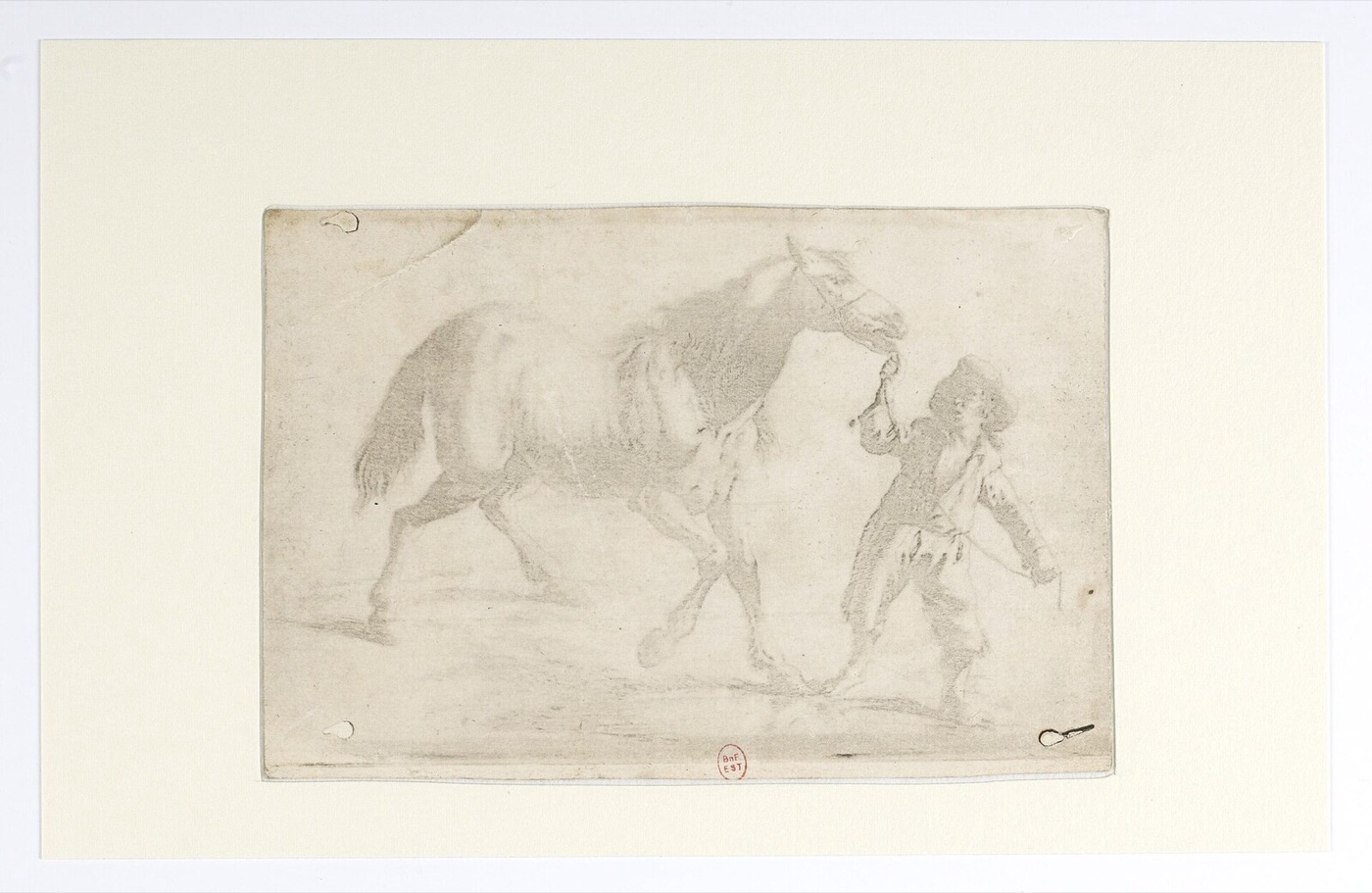
Because the plates could then be etched with acid and printed. In 1825 he used the method to copy a Dutch engraving onto a copper plate: after washing away the soft bitumen, acid bit grooves into the bare metal, which could be inked and printed on paper like an engraving. In 2002 the National Library of France bought one paper print made this way.[10][11] Earlier, in 1822, he varnished the back of an engraved portrait of Pope Pius VII to make the paper translucent and laid it on a bitumen-coated glass plate to copy it by contact in sunlight; even in direct sun this took three or four hours.[10] The Le Gras plate itself was never etched or printed.
How long did the first photograph's exposure take?
At least several hours, and quite possibly several days.
- The long-popular figure was about 8 hours, based on the walls on both the left and right of the picture looking sunlit, suggesting the exposure spanned most of a day.
- In the 1990s the French chemist Jean-Louis Marignier reconstructed the original process and concluded that 8 hours was far too short; it probably took several days.[12][13]
- The Harry Ransom Center now also says "several days".[1]
Why did bitumen need such long exposures?
Because bitumen is extremely insensitive to light, and the light in a camera obscura is weak. Light has to cross-link the large bitumen molecules into a network before the solvent can no longer wash them away, and each bit of light has only a small chance of doing so, so a great deal of light is needed.[12][13] Contact copying an engraving in direct sun took three or four hours; in a camera obscura, the light is what scatters off walls, trees and roofs, and the lens catches only a small share of it, far dimmer than direct sun. So the time stretched to days.
What happened to the plate afterwards?
It stayed in England, changed hands several times, and is now in an American museum. In autumn 1827 Niépce went to Kew, near London, to visit his gravely ill brother Claude, and tried to present his method to the Royal Society through the botanical artist Francis Bauer. He did not succeed; the usual explanation is that he would not reveal his recipe.[14] He left the plate with Bauer. After several owners, it was last shown publicly in 1905 and then lost. In 1952 the photo historian Helmut Gernsheim found it in a trunk stored by an English family, and in 1963 it entered the Harry Ransom Center.[1] Today it sits in a sealed, oxygen-free case, with oxygen, pressure, humidity and temperature monitored continuously[15]; it is scheduled to be lent to France in 2027 and shown in Niépce's home town.[16]
What came after Niépce?
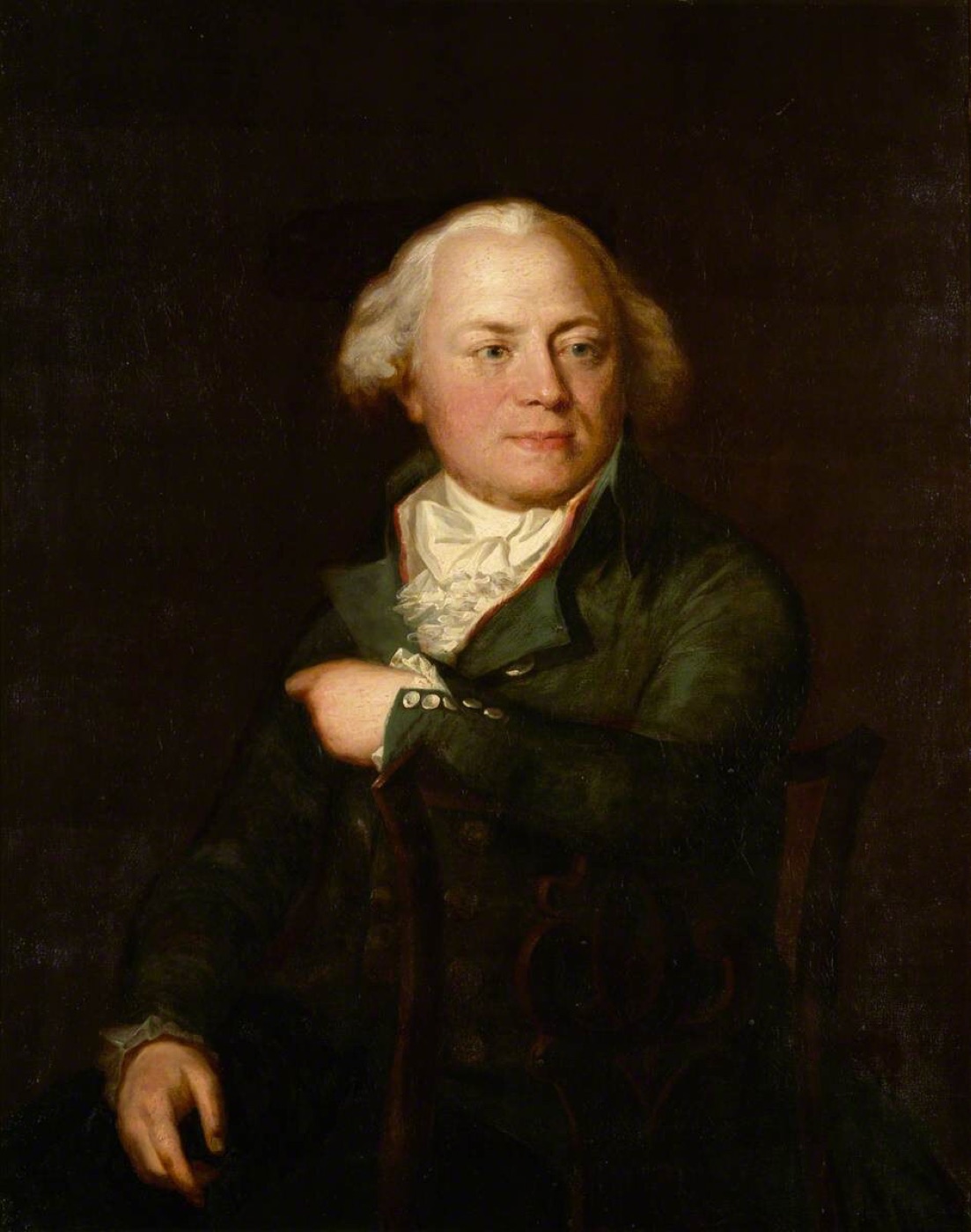
Louis Daguerre took over. In December 1829 Niépce signed a partnership agreement with Daguerre, a Paris painter and stage designer; when Niépce died suddenly at Le Gras in July 1833, his son Isidore Niépce took his place in the partnership.[17] A few years later Daguerre found a much faster method and made it public in 1839.
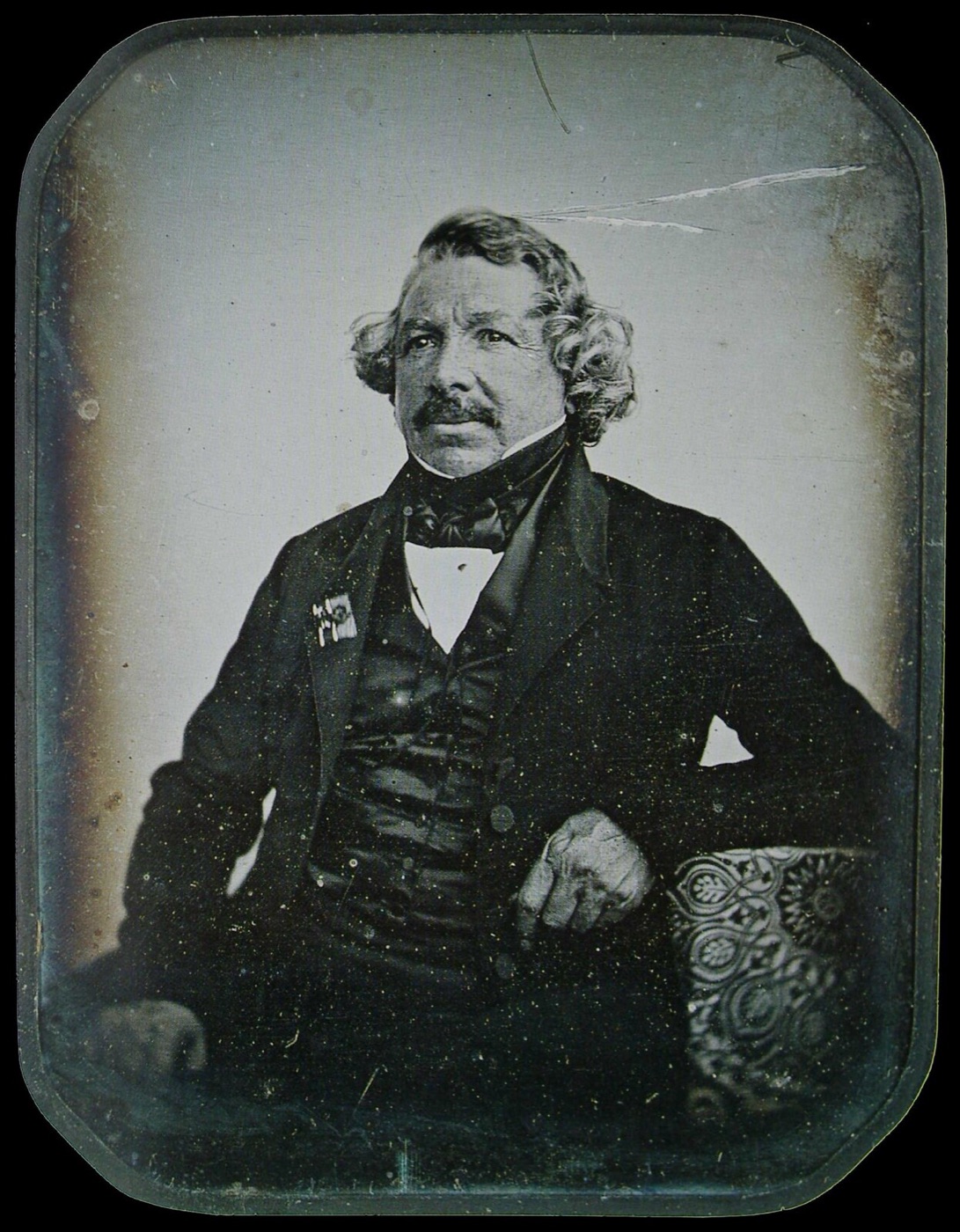
Bottom line: the first photograph was slow because bitumen needs enormous amounts of light to harden, while a camera obscura can supply only a little. Niépce proved that the image in a camera obscura could be kept; making it fast was left to those who came after.
Sources
- Harry Ransom Center, "The First Photograph". https://www.hrc.utexas.edu/niepce-heliograph/
- Maison Nicéphore Niépce, history of the house. https://bicentennial-of-photography.org/history-house-niepce/
- Maison Nicéphore Niépce, catalogue of works. https://bicentennial-of-photography.org/catalog-works-niepce/
- UT News, 2003-11-21. https://news.utexas.edu/2003/11/21/results-from-the-first-photograph-undergoing-scientific-tests
- Britannica, "Johann Heinrich Schulze". https://www.britannica.com/biography/Johann-Heinrich-Schulze
- Humphry Davy, "An Account of a Method of Copying Paintings upon Glass…", Journals of the Royal Institution, 1802; DNB "Wedgwood, Thomas". https://en.wikisource.org/wiki/Wedgwood,_Thomas_(DNB00)
- Maison Nicéphore Niépce, his first experiments. https://bicentennial-of-photography.org/niepce-and-the-invention-of-photography-niepce-s-first-experiments/
- AIC Conservation Wiki, "Heliograph (Niepce)". https://conservation-wiki.com/wiki/Heliograph_(Niepce)
- Niépce, Notice sur l'héliographie, 1829 (English translation). https://arthistoryproject.com/artists/nicephore-niepce/description-of-heliography/
- Maison Nicéphore Niépce, the invention of photoengraving. https://bicentennial-of-photography.org/niepce-and-the-invention-of-photography-invention-of-photoengraving/
- Légifrance, notice of April 2002. https://www.legifrance.gouv.fr/jorf/id/JORFTEXT000000217393
- J.-L. Marignier, "Historical light on photography", Nature 346, 115 (1990). https://www.nature.com/articles/346115a0
- J.-L. Marignier, Journal of Imaging Science and Technology 40(2), 1996. https://library.imaging.org/jist/articles/40/2/art00008
- History of Information, Niépce in England. https://www.historyofinformation.com/detail.php?id=3665
- WAAC Newsletter 24.3 (2002). https://cool.culturalheritage.org/waac/wn/wn24/wn24-3/wn24-305.html
- Artprice. https://news.artprice.com/en/16430/bicentenary-of-photography-the-first-image-in-history-to-be-exhibited-in-france-in-2027
- Encyclopædia Universalis, "Louis Jacques Mandé Daguerre". https://www.universalis.fr/encyclopedie/louis-jacques-mande-daguerre/
Compiled by photographer and photography lecturer Travis Zhang from the course script; every fact is checked against the sources.