
From the Pinhole · Lesson 11
Did all four hooves leave the ground at once?
The text version of a lesson from Photography with Travis Zhang. All lessons →
In short: yes, but not the way painters showed it. In June 1878 the photographer Eadweard Muybridge used a row of 12 cameras in California to catch a galloping horse with all four hooves off the ground, legs tucked under its belly rather than stretched out front and back. The 1872 argument that started it all was actually about the trot, not the gallop. The horse itself closed the electric circuit that fired the shutters, and the whole series took under half a second.
Is the painted "flying gallop" real?
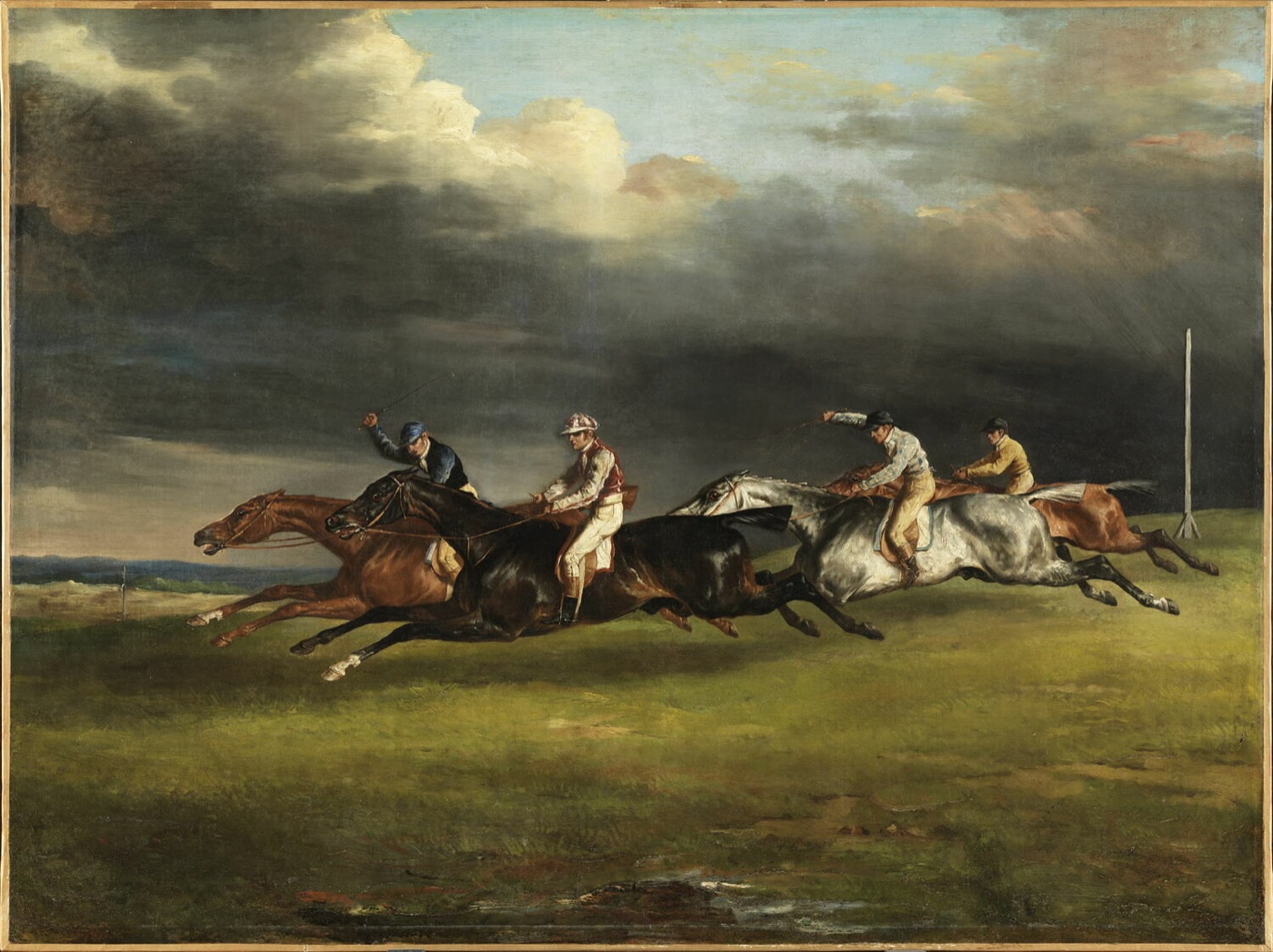
No. In 1821 the French painter Théodore Géricault, working in England, painted a horse race now usually called "The Epsom Derby": all four horses stretch their front legs forward and hind legs back, hooves in the air. This pose is known as the "flying gallop".[1] A horse moves too fast for the eye to follow, so painters had to guess. None of Muybridge's galloping horses ever struck that pose.
What was the 1872 argument really about?
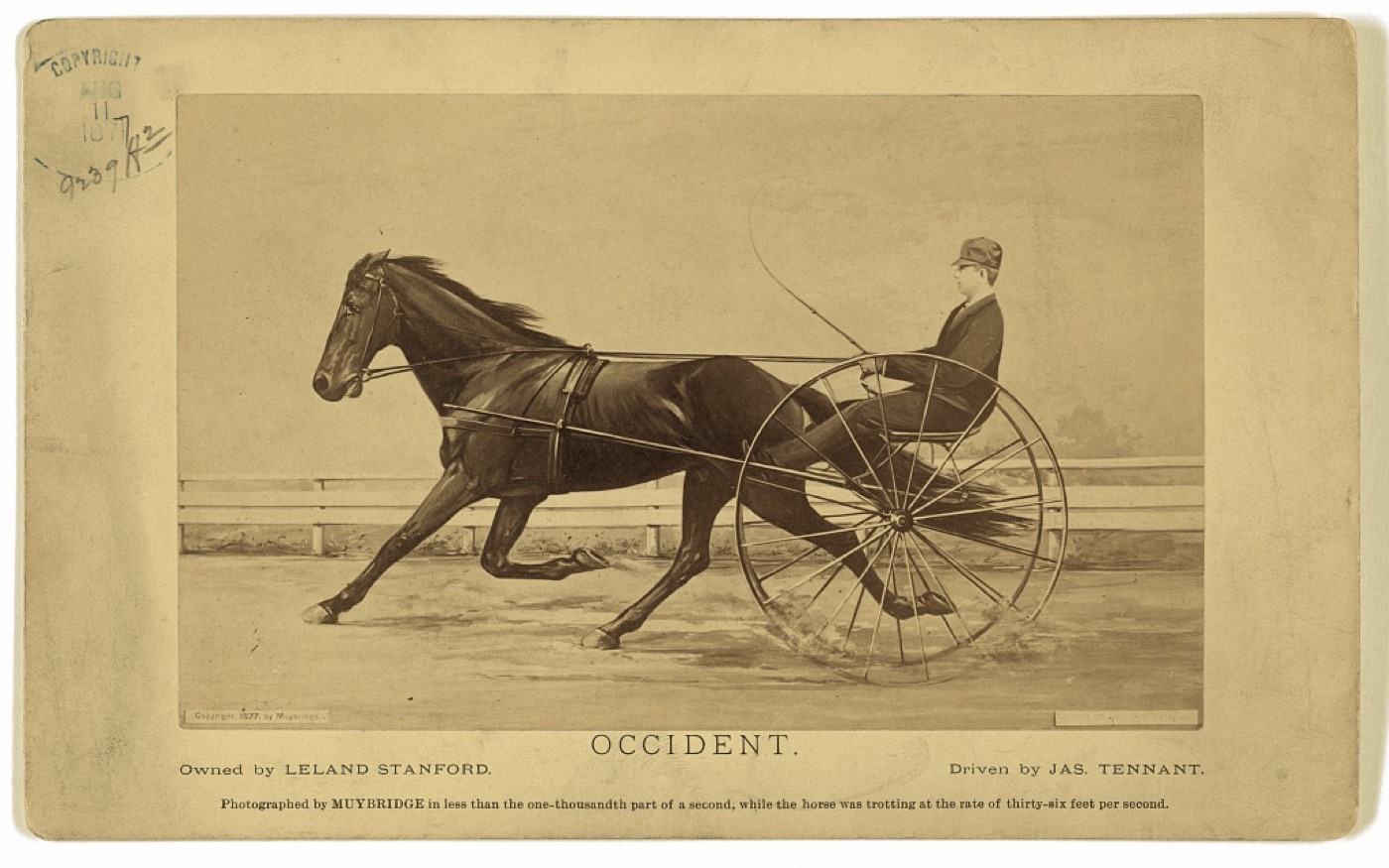
The trot, not the gallop: does a trotting horse ever have all four hooves off the ground at once? One side was the owner of a San Francisco newspaper; the other was Leland Stanford.[2][3] Stanford was a railroad president, a former governor of California and a keen owner of racehorses; his Occident was a trotter pulling a light two-wheeled cart. Many books say he bet twenty-five thousand dollars on it, but no record of a bet from the time has been found, and Muybridge's own books mention only an argument.[4][5]
Why can't Muybridge's 1877 photograph be trusted?
Because the "photograph" on the card was a copy of a painting. In July 1877 he photographed Occident again and sent a card to the papers claiming an exposure of under a thousandth of a second. One paper was suspicious: either the camera lied, or Stanford owned the most extraordinary horse in the world. Muybridge admitted in a letter that the picture had been retouched, as was usual. Researchers later X-rayed a retoucher's oil painting in Stanford's art museum: apart from the driver's face, a pasted-on scrap of photograph, it was all painted by hand.[4][6]
How did the 12 cameras of 1878 work?
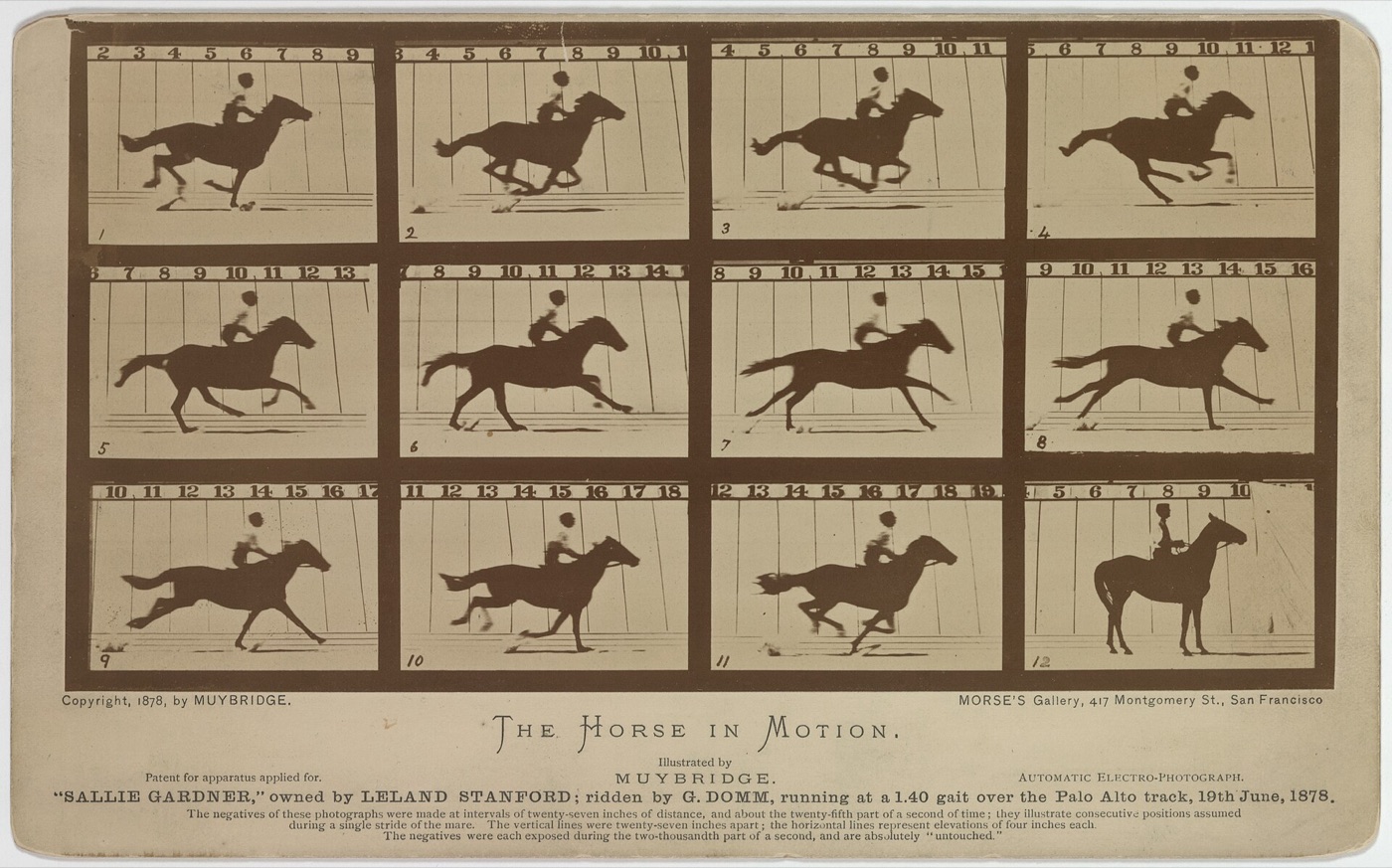
The horse pressed its own shutter button. In June 1878, at Stanford's Palo Alto farm, Muybridge set 12 cameras in a row along the track, 21 inches (about half a metre) apart, with a white screen 15 feet high opposite and powdered lime on the ground.[4][3] For a trotter pulling a cart, the wheel rolled over a wire on the track; for a ridden horse, its chest broke a thread stretched across. Either way the circuit closed, an electromagnet on each camera pulled out a catch, and two boards snapped across the lens in opposite directions. The popular claim that hooves tripped the thread is wrong.[3] The exposure of about a two-thousandth of a second was his own claim, never independently measured; the price was horse and rider almost black.
Which frames show all four hooves in the air?
The second and third frames of the Sallie Gardner card, dated 19 June 1878. It has 12 frames: the first 11 show the horse running, and the last, photographed separately, shows it standing.[7] At the moment of lift-off the legs are tucked under the belly, hooves close together. Muybridge later wrote that the only phase in which a galloping horse had been found unsupported was with its legs gathered under its body.[2] The trotter Abe Edgington was photographed in front of reporters on 15 June: twelve pictures in under half a second, developed beside the track. And the trot of 1872? A fast trotter leaves the ground too, as its diagonal pairs change over.
Did he make the horse run on a screen, and is that cinema?
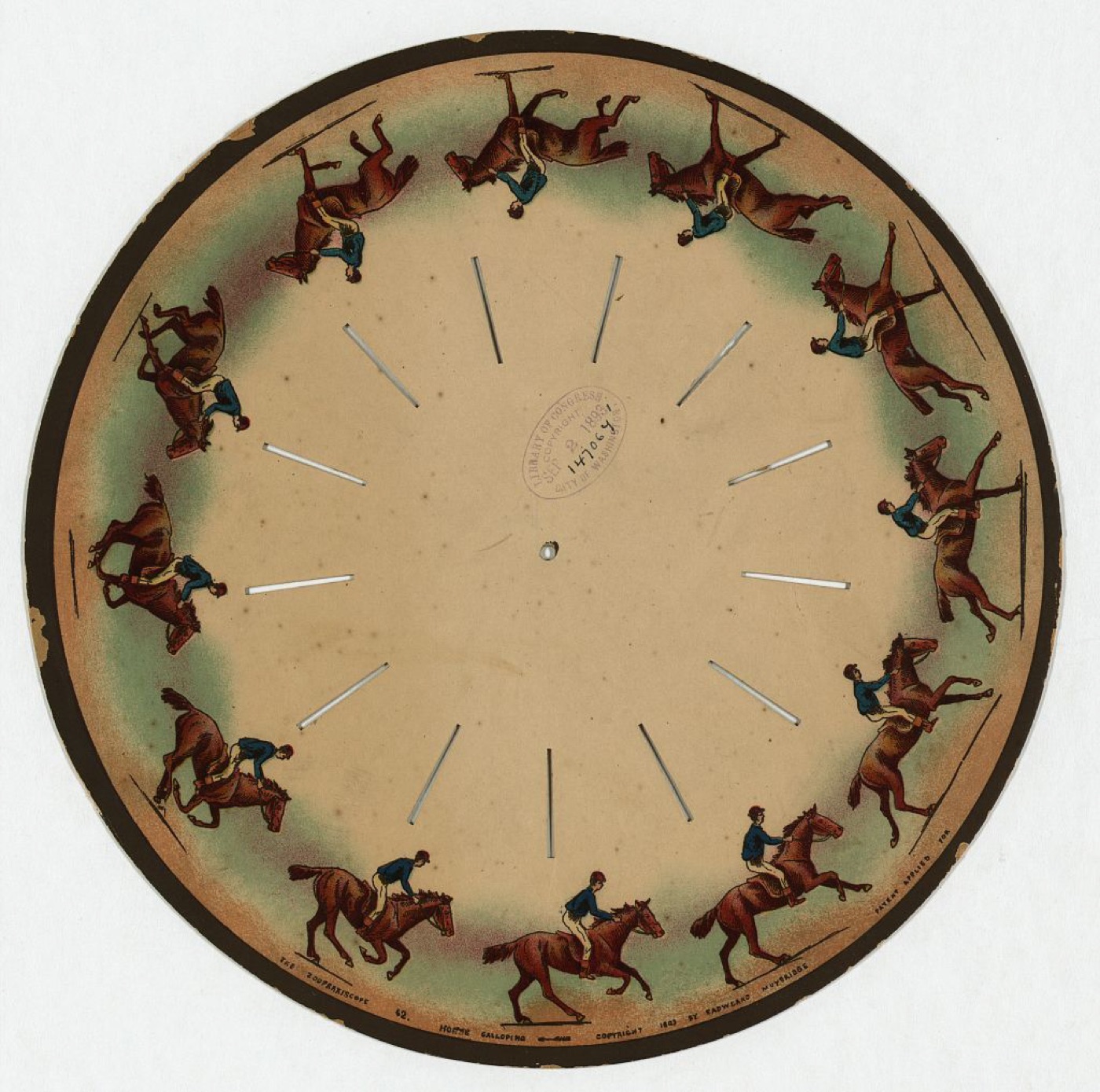
He made it run, but it was not yet cinema. Muybridge traced the photographs onto a glass disc, spun it and projected it with a lamp; he called the machine the zoopraxiscope, and gave its first public show at the San Francisco Art Association on 4 May 1880.[4] He did not invent the motion picture: he had no film and no camera that could shoot a series on its own. In Paris, Étienne-Jules Marey built his photographic gun in 1882, one camera taking 12 pictures a second; on 28 December 1895 the Lumière brothers sold tickets for a projected show in Paris.[8][9]
Were later photographs clearer than the 1878 silhouettes?
Much clearer. In 1884 Muybridge moved to the University of Pennsylvania and switched to far faster dry plates: 24 cameras in a row, plus two banks of 12 firing from oblique angles at the same moment. Animal Locomotion, published in 1887, has 781 plates and over twenty thousand images, no longer mere silhouettes.[10][11] The prospectus called the plates "untouched", but scholars and the Kingston Museum note that some sequences were rearranged or substituted.[12]
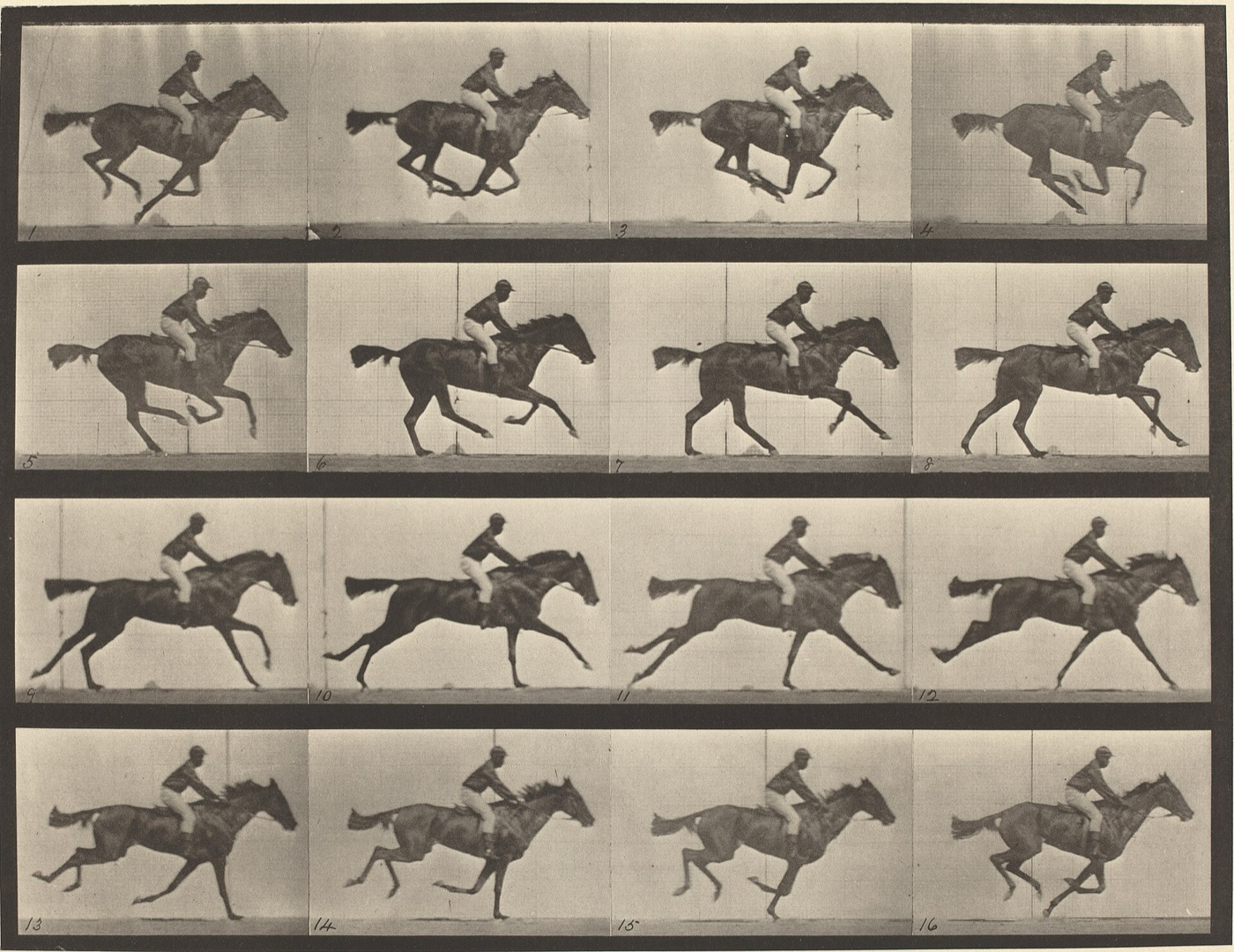
Whose photographs were they?
It was disputed: Muybridge said they were his, Stanford's book described him as a hired photographer, and in 1885 the court ruled against him. In 1882 Stanford published "The Horse in Motion"; its title page names Dr J. D. B. Stillman as author, and Stanford's preface says "I employed Mr. Muybridge".[3] Muybridge wrote a public letter in Nature saying the method was his invention and the patent and copyright his, then sued Stanford for fifty thousand dollars; on 13 February 1885 the court dismissed the suit.[4]
Bottom line: a galloping horse really does have all four hooves off the ground, at the moment its legs are tucked under its belly. We know it not from one photograph but from a row of cameras fired by the horse itself, capturing the stride in under half a second.
Sources
- Ministère de la Culture, Joconde 000PE001278: Théodore Géricault, Course de chevaux, dit traditionnellement le Derby de 1821 à Epsom, Musée du Louvre, MI 708. https://www.pop.culture.gouv.fr/notice/joconde/000PE001278
- Eadweard Muybridge, Descriptive Zoopraxography, or the Science of Animal Locomotion Made Popular (Philadelphia, 1893), pp. 4–9, 40. https://archive.org/details/descriptivezoopr00muyb
- J. D. B. Stillman, The Horse in Motion as Shown by Instantaneous Photography (Boston: James R. Osgood, 1882), preface by Leland Stanford and appendix pp. 123–127. https://archive.org/details/horseinmotionass00stil_0
- Anita Ventura Mozley et al., Eadweard Muybridge: The Stanford Years, 1872–1882 (Stanford University Museum of Art, 1972). https://archive.org/details/eadweardmuybridg00maye
- Allain Daigle, "Not a Betting Man: Stanford, Muybridge, and the Palo Alto Wager Myth", Film History 29, no. 4 (2017): 112ff. https://doi.org/10.2979/filmhistory.29.4.05
- "Occident." Owned by Leland Stanford. Driven by Jas. Tennant (card, 1877), Library of Congress 2005694393. https://commons.wikimedia.org/wiki/File:Occident._Owned_by_Leland_Stanford._Driven_by_Jas._Tennant_LCCN2005694393.jpg
- Eadweard Muybridge, The Horse in Motion: "Sallie Gardner," owned by Leland Stanford; ridden by G. Domm (card, 19 June 1878), Library of Congress 97502309. https://commons.wikimedia.org/wiki/File:Eadweard_Muybridge-Sallie_Gardner_1878.jpg
- Étienne-Jules Marey, "Le fusil photographique", La Nature, 22 April 1882 (CNAM digital library); Université Paris Cité, BIU Santé, "Marey and chronophotography". https://numerabilis.u-paris.fr/medica/bibliotheque-numerique/presentations/marey/03-en.php
- Library of Congress, "Origins of Motion Pictures" (essay in the Edison Company motion pictures collection). https://www.loc.gov/collections/edison-company-motion-pictures-and-sound-recordings/
- Eadweard Muybridge, Animal Locomotion: Prospectus and Catalogue of Plates (Philadelphia, 1887). https://archive.org/details/cu31924024580353
- University of Pennsylvania, Animal Locomotion: The Muybridge Work at the University of Pennsylvania (Philadelphia: Lippincott, 1888). https://archive.org/details/animallocomotion00univ_0
- Kingston Museum, "Muybridge in Kingston": biography, timeline and collection highlights. https://muybridgeinkingston.co.uk/eadweard-muybridge/


Compiled by photographer and photography lecturer Travis Zhang from the course script; every fact is checked against the sources.