
From the Pinhole · Lesson 8
How did people in the nineteenth century scroll through photographs? Cartes de visite, stereographs and Nadar's studio
The text version of a lesson from Photography with Travis Zhang. All lessons →
In short: they leafed through photo albums or held a stereoscope up to their eyes. From the 1850s, a wet-collodion glass negative could be printed many times over; in 1854 the Paris photographer Disdéri patented a way to take eight small portraits on one plate, the card-sized "carte de visite", and stereoscopes and stereo photographs were sold by the thousand into ordinary homes. By the 1860s, swapping and collecting cartes had become a craze. At the same time, Nadar in Paris went the other way: not more and cheaper, but a portrait that caught a person's character.
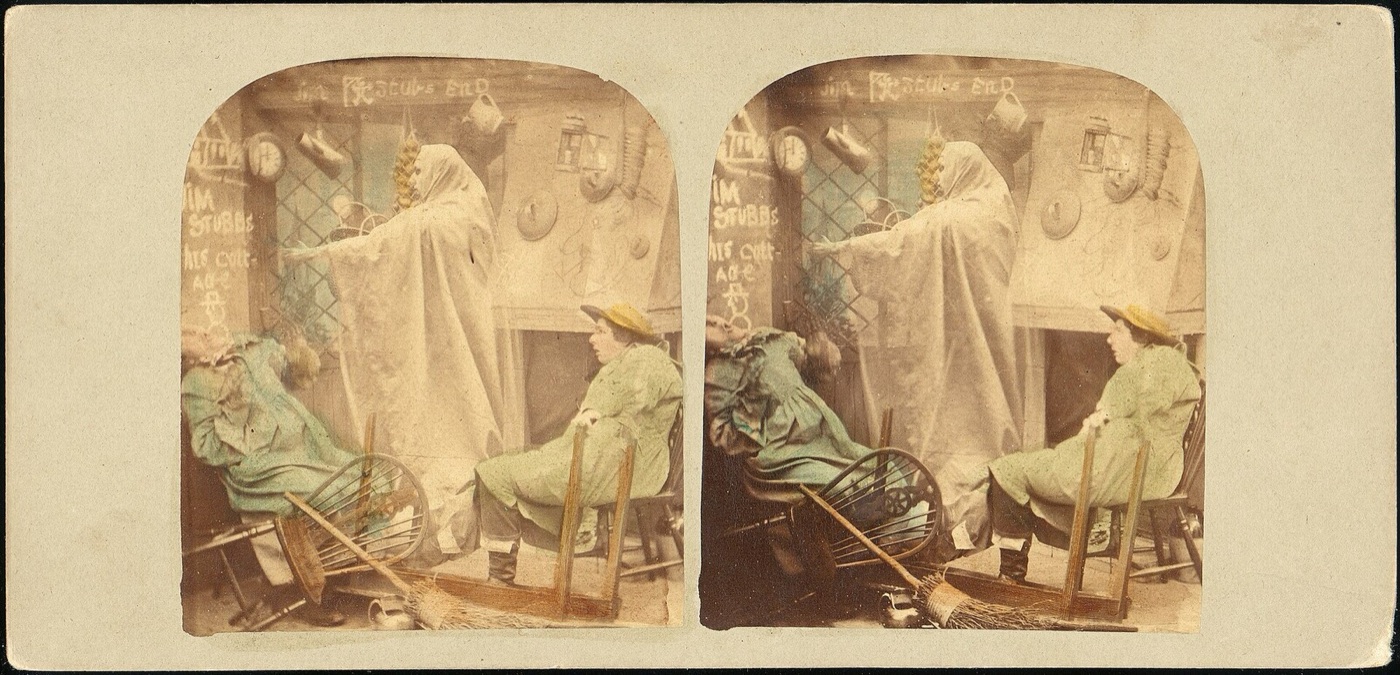
How does a stereo photograph stand up in depth?
It works because each of your two eyes sees a slightly different picture. The eyes are six or seven centimetres apart, and the brain merges the two views to judge near and far. In 1838 the English physicist Charles Wheatstone published a paper on this and built a stereoscope from two mirrors, at first for hand-drawn line figures.[1] A stereo photograph is two pictures taken from positions about one eye-width apart, mounted side by side on a card; in a stereoscope the left eye sees only the left picture and the right eye only the right.[2] VR headsets still use the same principle.
How popular was the stereoscope?
Very: in 1856 the Scottish physicist David Brewster wrote that an estimated half a million or more of his lens stereoscopes had been sold worldwide.[2] In 1849 he had swapped the mirrors for lenses in a small hand-held box; after it was shown at the Great Exhibition in London in 1851, Queen Victoria, by his own account, took a special interest.[2] In 1854 a London company opened to sell nothing but stereoscopes and stereographs.[3]
Who called photography "the mirror with a memory"?
The American writer Oliver Wendell Holmes, in an 1859 essay devoted to stereographs. He also wrote that the look of a thing could now be separated from the thing itself, and imagined future libraries of stereographs.[4] He later designed a simple hand-held stereoscope that Joseph L. Bates of Boston made in quantity from about 1861; neither man patented it, so copies appeared everywhere.[5]
What was a carte de visite?
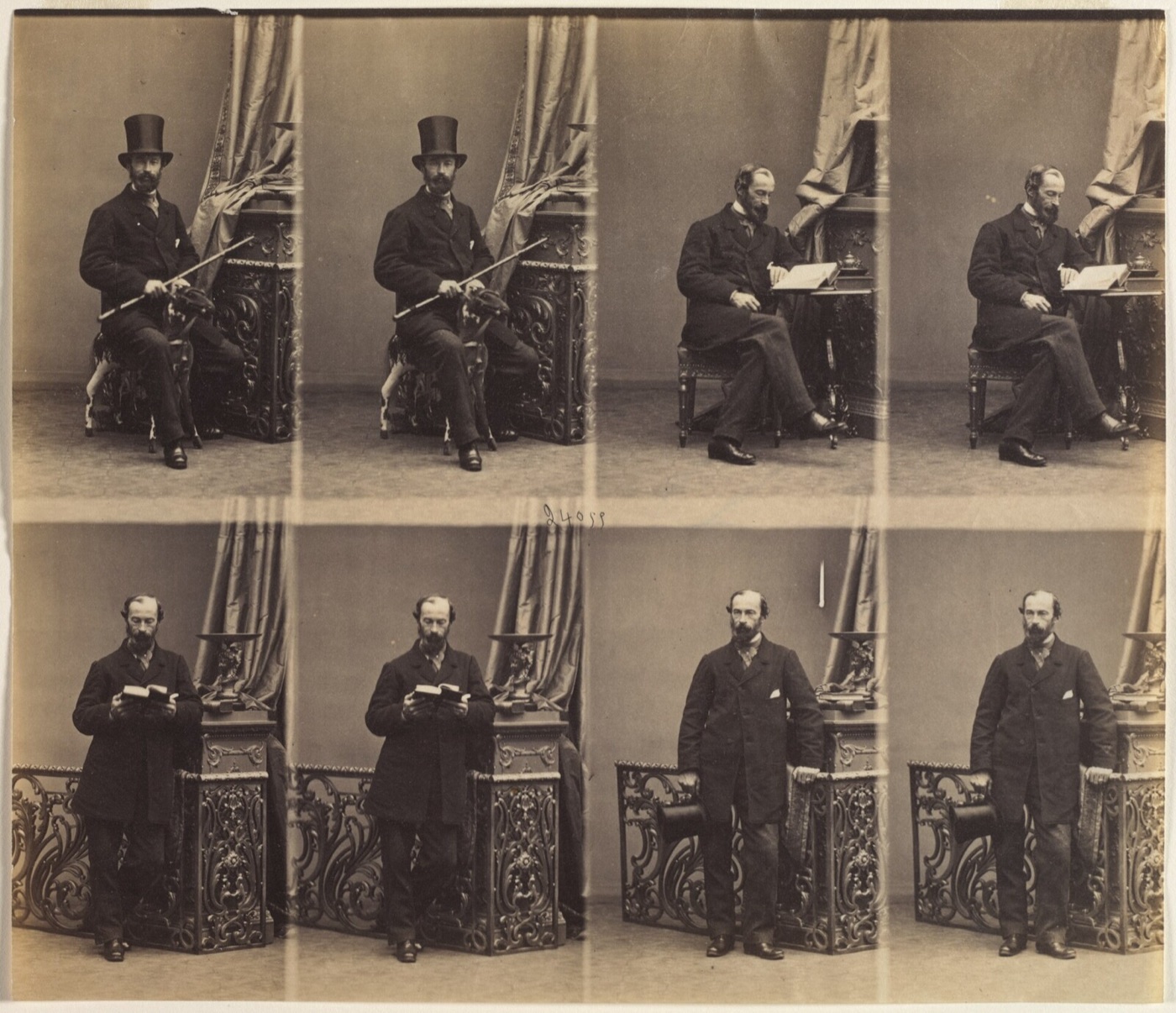
A carte de visite was a small portrait photograph the size of a visiting card, about 6 by 10 centimetres, mounted on stiff card. In November 1854 the Paris photographer André-Adolphe-Eugène Disdéri patented taking several small pictures on one glass negative; the usual set-up was a camera with four lenses and a sliding plate holder, giving eight pictures per plate, printed and then cut apart.[6][7] It saved glass, chemicals and the photographer's time; Nadar said it gave far more for far less money.[8] Disdéri's cartes were mostly full-length figures with a drape behind and a table, chair or column alongside.[9]
Did Napoleon III make the carte de visite famous?
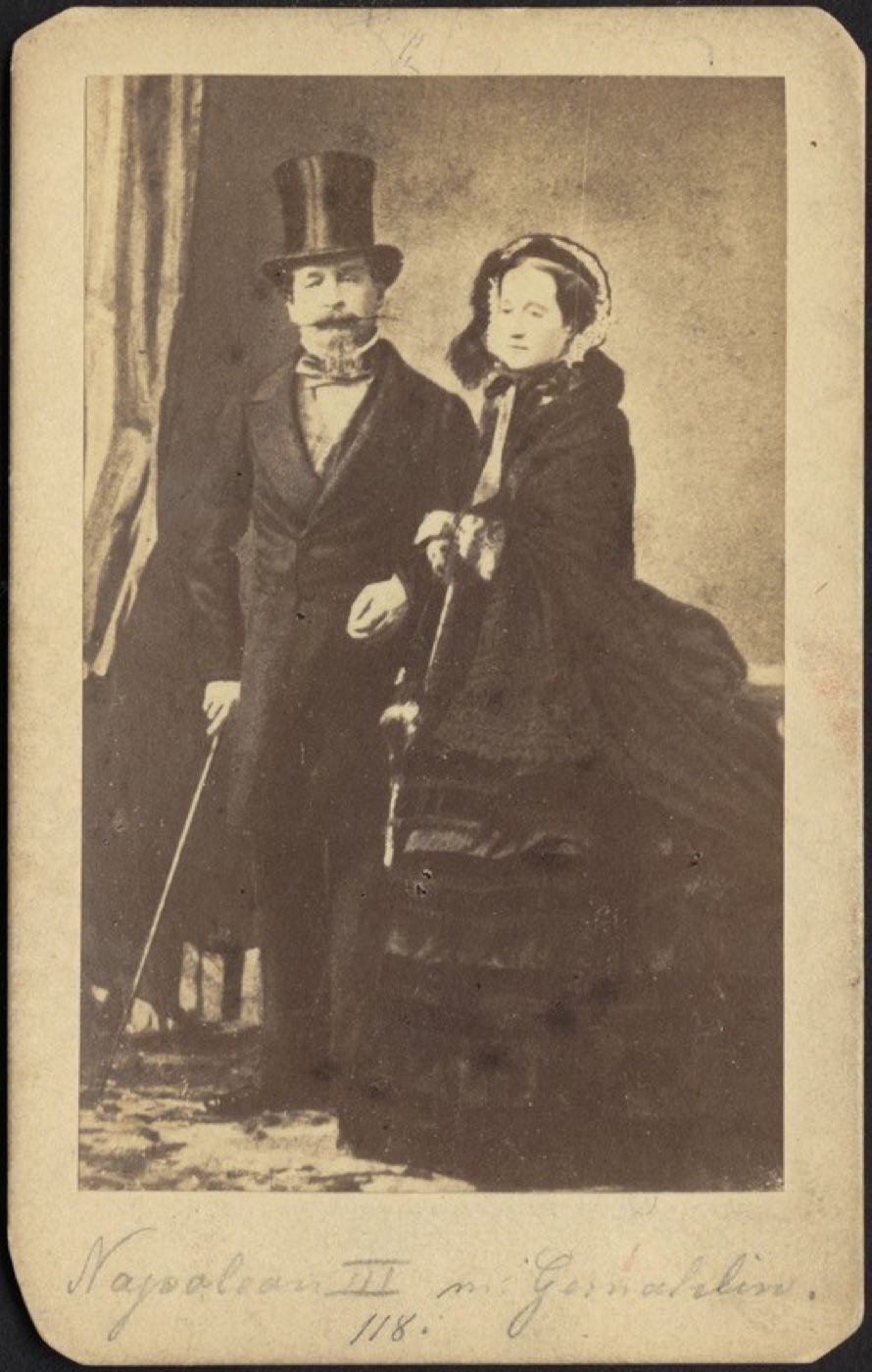
That story is widely told but shaky. It goes that in May 1859, on his way to the war in Italy, Napoleon III halted his army outside Disdéri's studio and went in to be photographed. Several Paris papers did report that the emperor sat for him, but the halted army comes from Nadar's memoirs forty years later; Disdéri scholar Elizabeth Anne McCauley doubts it, and the British researcher Paul Frecker considers the whole tale made up.[10][11] What is certain: in July 1859 Disdéri became photographer to the emperor, and his studio, reopened in autumn 1857, went from about seventy sittings a month in its first months to more than nine hundred a month by spring 1860.[10]
What was "cartomania"?
Cartomania was the 1860s craze for cartes de visite in Europe and America: people swapped them, slotted family and friends into special albums, and bought printed cartes of emperors, queens, actors and writers.[6][12] In Britain a large studio portrait cost two to four pounds, while a celebrity carte from a stationer cost little more than a shilling.[12]
Why did Nadar's portraits look different?
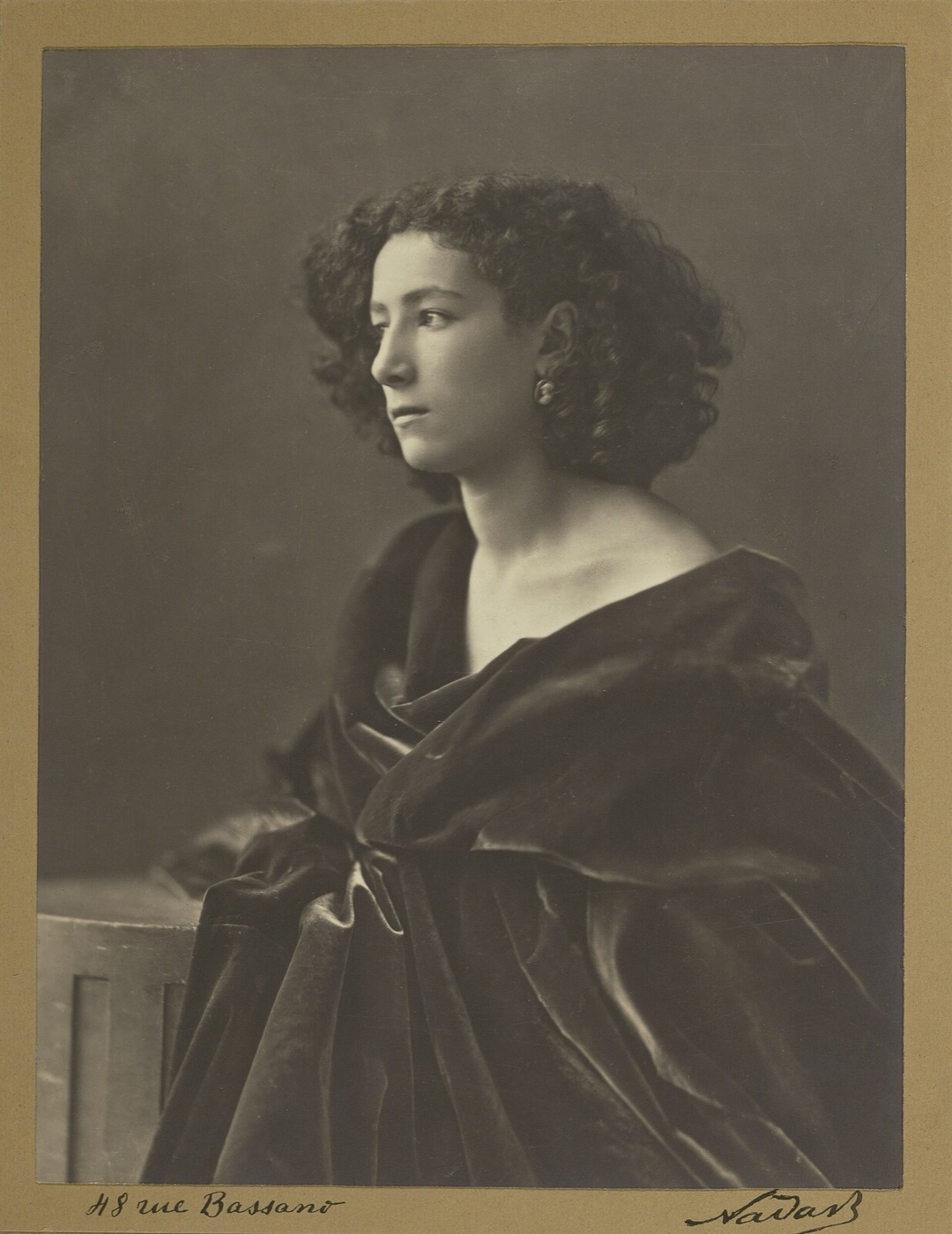
Because he looked only at the face. Nadar, born Gaspard-Félix Tournachon, began as a caricaturist and took up portraits in 1854–55. He used plain backgrounds, framed people close, and talked with his sitters to read their character; he aimed for the most intimate likeness and called it the psychological side of photography.[13] He photographed Baudelaire, Delacroix, George Sand and the young Sarah Bernhardt, then around twenty.[14]
What else did Nadar photograph?
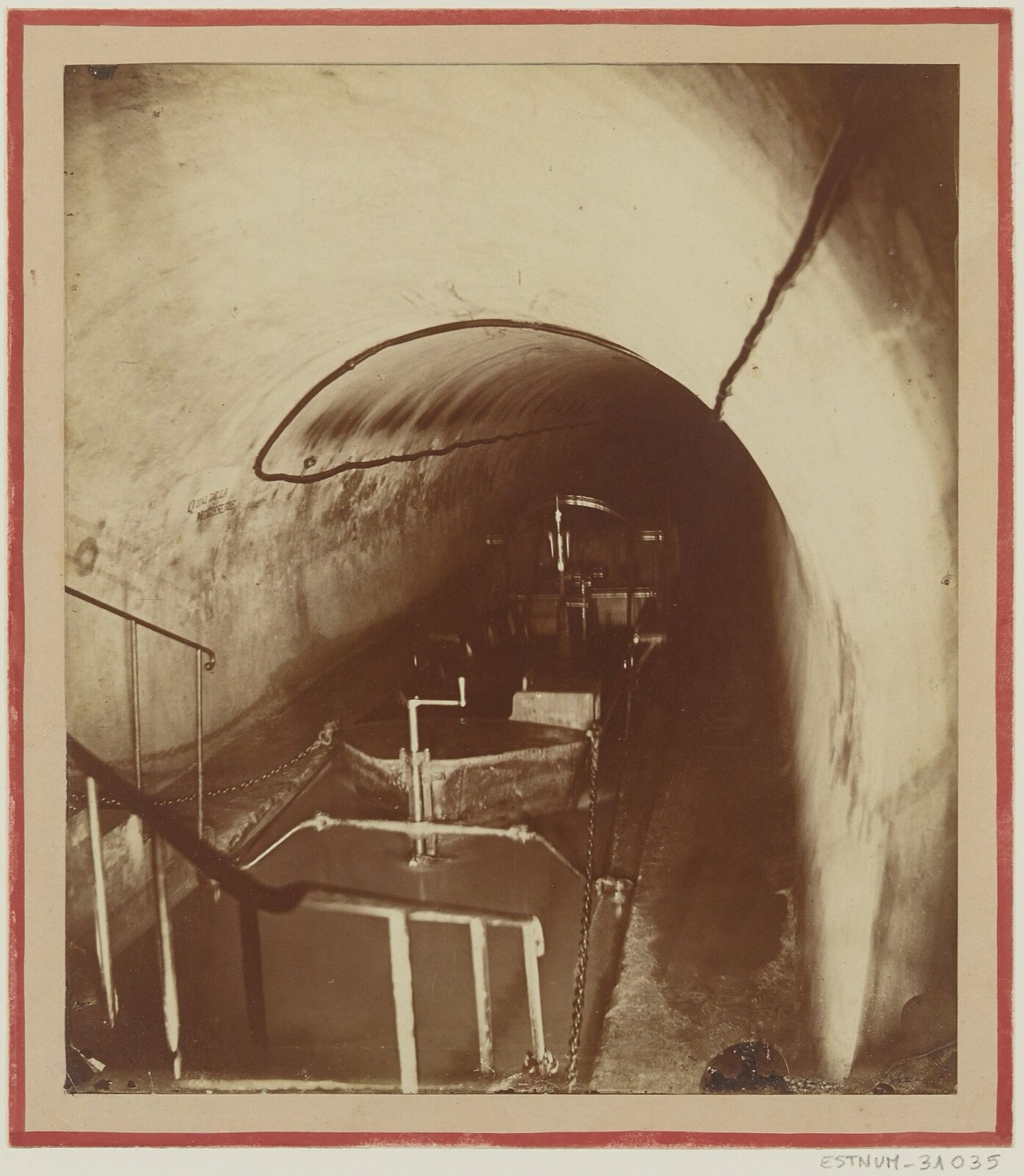
He also photographed Paris from a balloon and the catacombs by electric light, and his old studio hosted the first Impressionist exhibition.
- In 1858 he photographed the outskirts of Paris from a tethered balloon about 80 metres up, the earliest recorded aerial photograph, though it does not survive; the oldest surviving one is James Wallace Black's Boston of 1860.[14][15]
- In 1861 he patented photography by electric arc light and went down into the Paris catacombs. The batteries were too heavy, so they stayed up on the street and long wires carried the current down; some exposures ran to 18 minutes, so he used mannequins dressed as workmen instead of people.[8][14]
- On 15 April 1874 the first Impressionist exhibition opened in his former studio at 35 boulevard des Capucines.[16]
- In 1886 he and his son Paul interviewed the chemist Chevreul, nearly a hundred years old; the photographs ran with the dialogue in a magazine, often called the first photo-interview.[17]
Bottom line: nineteenth-century "scrolling" rested on wet plates that printed many copies, eight-to-a-plate cartes de visite and mass-produced stereographs; Nadar showed that once photographs were everywhere, a portrait could still aim at one person's character.
Sources
- Charles Wheatstone, "Contributions to the Physiology of Vision. Part the First", Philosophical Transactions of the Royal Society 128 (1838): 371–394. https://doi.org/10.1098/rstl.1838.0019
- David Brewster, The Stereoscope: Its History, Theory, and Construction (London, 1856). https://www.gutenberg.org/cache/epub/71483/pg71483.txt
- Science and Media Museum Blog, "A–Z of photography: L is for London Stereoscopic Company". https://blog.scienceandmediamuseum.org.uk/a-z-photography-l-is-for-london-stereoscopic-company/
- Oliver Wendell Holmes, "The Stereoscope and the Stereograph", The Atlantic Monthly (June 1859). https://www.theatlantic.com/magazine/archive/1859/06/the-stereoscope-and-the-stereograph/303361/
- The Philadelphia Photographer, vol. 6 (1869), incl. O. W. Holmes, "History of the American Stereoscope". https://archive.org/details/philadelphiaphot1869phil
- The Metropolitan Museum of Art, Malcolm Daniel, "The Industrialization of French Photography after 1860", Heilbrunn Timeline of Art History. https://www.metmuseum.org/toah/hd/infp/hd_infp.htm
- INPI (Institut national de la propriété industrielle), patent archives, via Google Arts & Culture. https://artsandculture.google.com/story/wwWBsrxxvsD8JQ
- Nadar, Quand j'étais photographe (Paris: Flammarion, 1900). https://archive.org/details/quand-jetais-photographe-nadar-preface-de-leon-daudet
- The Metropolitan Museum of Art, Disdéri, Prince Lobkowitz (1858), 267168. https://www.metmuseum.org/art/collection/search/267168
- "Elisabeth Francart, 'Madame Disdéri'", Fotocinema. Revista científica de cine y fotografía (Universidad de Málaga). https://revistas.uma.es/index.php/fotocinema/article/download/20549/21275?inline=1
- Luminous-Lint, "André Adolphe-Eugène Disdéri", virtual exhibition with notes by Paul Frecker. https://luminous-lint.com/phoenix/virtual_exhibits/single/_PHOTOGRAPHER_Andre_Adolphe-Eugene__Disderi_01/checklist/
- Science and Media Museum Blog, "An introduction to the carte de visite". https://blog.scienceandmediamuseum.org.uk/an-introduction-to-the-carte-de-visite/
- The Metropolitan Museum of Art, Malcolm Daniel, "Nadar (1820–1910)", Heilbrunn Timeline of Art History (2004). https://www.metmuseum.org/toah/hd/nadr/hd_nadr.htm
- Bibliothèque nationale de France, "Les Nadar, une légende photographique", dossier de presse (2018). https://www.bnf.fr/sites/default/files/2019-01/dp_nadar.pdf
- The Metropolitan Museum of Art, James Wallace Black, Boston, as the Eagle and the Wild Goose See It (1860), 283189. https://www.metmuseum.org/art/collection/search/283189
- National Gallery of Art and Musée d'Orsay, "Paris 1874: Inventing Impressionism", wall texts (2024). https://www.nga.gov/content/dam/ngaweb/press/exhibition/2024/5649/5649-walltext.pdf
- Bibliothèque nationale de France, "Les Nadar, une légende photographique", online exhibition. https://expositions.bnf.fr/les-nadar/
Compiled by photographer and photography lecturer Travis Zhang from the course script; every fact is checked against the sources.